



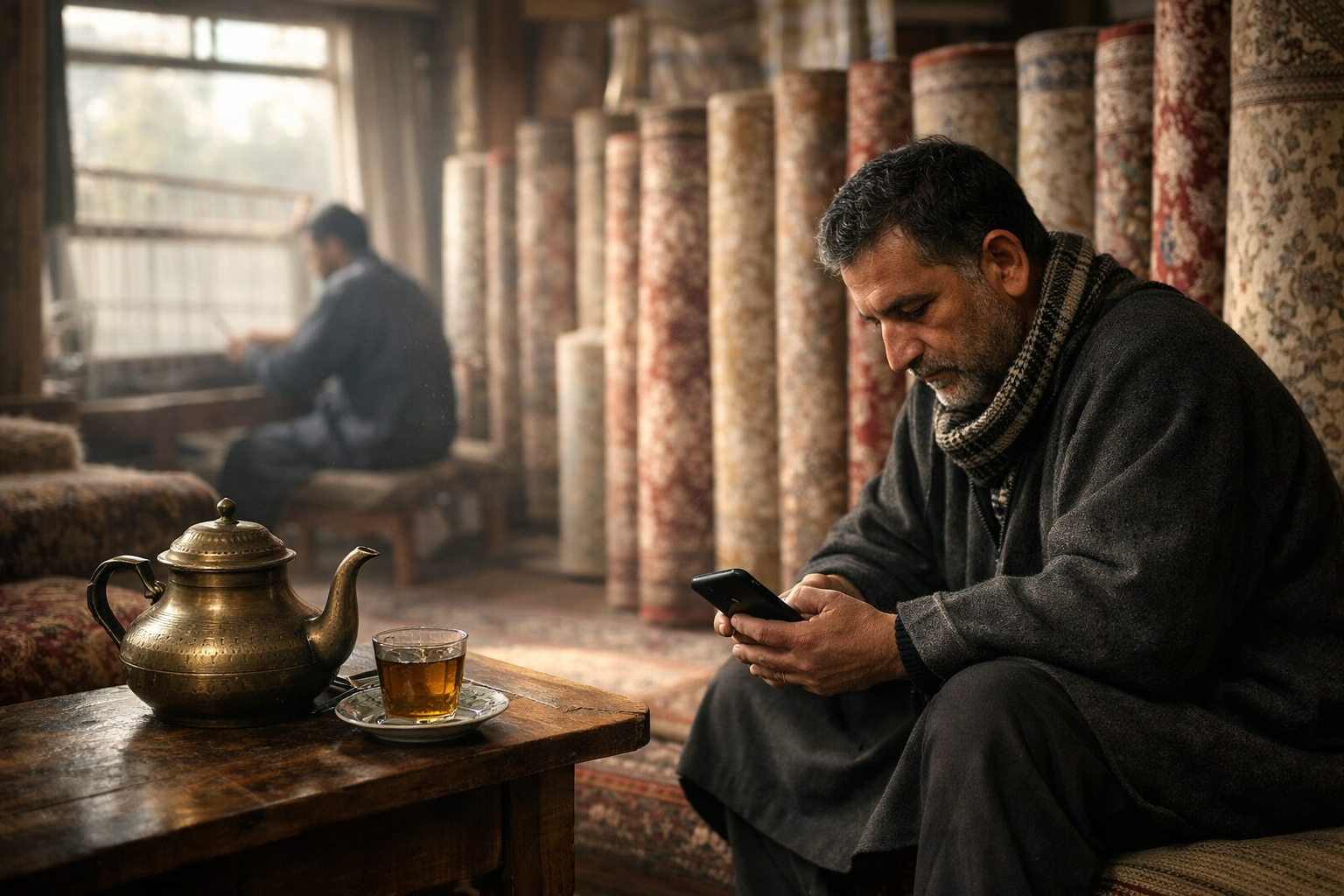
Morning light rests on rows of silk carpets in Ghulam Hassan Bhat’s showroom near the Dal Lake, each roll holding months of labour in its fine weave.
A kettle of kehwa cools nearby as Bhat checks his phone again, waiting for a message that will decide if the carpets leave, or stay.
“Buyers once confirmed shipments within days,” he says, setting the phone aside. “Now they ask us to wait. They speak about freight costs, rising insurance, and risk along the sea route.”
His family has exported carpets for three generations, building ties with retailers in Dubai, Doha and Riyadh. Orders once moved through established maritime routes linking India to West Asia, giving exporters a dependable path from workshop to showroom.
That path now faces disruption.
Escalating tensions involving Iran, Israel and the United States have altered shipping conditions along key corridors. Missile activity near the Strait of Hormuz and security concerns along Yemen’s coast have pushed shipping companies to revise operations.
Freight charges on the India-West Asia route have climbed by 30 to 50 percent since hostilities intensified, while insurers have introduced war-risk premiums for vessels passing through sensitive zones.
Exporters describe delays stretching from a few days into two or three weeks. Some buyers have stopped new orders altogether as they assess the situation.
“We prepared a consignment for Dubai last month,” Bhat says. “The buyer called and said he would wait. He wanted to see how things develop.”
That break sends a clear signal through Kashmir’s handicraft economy, a ₹2,500-crore sector that employs more than three lakh artisans in urban workshops and remote villages. Carpets and handicrafts alone generate between ₹600 and ₹700 crore annually, forming a significant share of income in a region with limited formal industry.
Around 2.5 lakh artisans work directly in production, while another one lakh support related roles such as spinning, dyeing, packaging and transport. When the full value chain is considered, from Pashmina goat herders in Ladakh to forwarding agents in Mumbai, four to five lakh livelihoods depend on this system.
Every link relies on the next.
On the outskirts of Srinagar, Bashir Ahmad stands beside a truck that once transported carpets regularly to Delhi’s cargo terminals. He flips through a worn notebook where trip entries have thinned.
“Trucks used to leave almost every week,” he says. “Now I wait for a call that comes less often. Drivers ask me when we will move again.”
Workshops throughout the valley produce items that demand time and precision. Silk carpets often contain up to 400 knots per square inch. Sozni embroidery requires months of careful stitching. Walnut wood furniture carries intricate carvings inspired by chinar leaves, while papier-mâché boxes feature detailed designs painted in mineral pigments.
These traditions extend over centuries, sustained through periods of political and economic strain. External shocks now influence them in immediate ways.
“Shipping disruptions raise costs for exporters, who adjust payments within the chain,” says Showkat Ali, a Srinagar-based carpet trade. “Buyers in Gulf markets respond with caution, reducing inventory purchases as regional uncertainty affects demand.”
Industry leaders estimate that fresh orders have declined by 30 to 40 percent since tensions escalated.
That contraction arrives at a sensitive moment. The sector had begun to recover from pandemic losses, supported by government promotion and renewed interest in Geographical Indication protections. Handicraft exports reached ₹917 crore in 2018-19 before falling sharply during COVID-19. Recent gains now face pressure.
The effect appears most clearly in villages where production takes place. Kanihama, known for Pashmina weaving, offers a close view of the change.
Inside a modest home, Rafiqa Begum works at a wooden loom set near a window. Threads stretch tightly in front of her, forming a developing shawl. A notebook nearby lists expenses and expected payments.
“Work arrived regularly before,” she says. “Now they tell us to wait for yarn. Waiting brings no income.”
Weavers depend on advances from traders, who rely on payments from exporters, who depend on buyers abroad. Disruption at the final stage tightens credit through each level.
Mohammad Yousuf, a shawl trader in Srinagar, describes the shift. “I reduced advances this month because payments have slowed,” he says. “One weaver borrowed money from relatives to pay school fees.”
This structure defines the craft economy. Each rupee of export value passes through multiple hands, including wool importers, dyers, apprentices and transport workers.
“When there is no order, I practice designs on paper,” says Aamir, a 19-year-old apprentice in downtown Srinagar. “My father asks me to look for other work.”
Such choices influence the future of the craft.
Skills develop over years of repetition, with knowledge embedded in both technique and memory. Interruptions can push workers toward other forms of labour, reducing the number of trained artisans over time.
Economic pressure extends beyond workshops.
Kashmir maintains strong ties to West Asia through labour migration. Government figures place about 87 lakh Indian workers in six major Gulf states, including 43 lakh in the United Arab Emirates and 27 lakh in Saudi Arabia. Jammu and Kashmir contributes a smaller share, receiving roughly 0.3 percent of India’s $80 billion annual remittance inflow, though dependence remains concentrated in specific communities.
In Pulwama, Danish Ahmad listens to voice messages from his brother in Dubai, who works in a hotel. Reduced working hours have lowered his earnings in recent weeks.
“He says business has slowed,” Danish explains. “His extra shifts helped us pay our home loan. Now we think about the next installment.”
Rising oil prices linked to regional tensions add another layer of strain. Higher crude costs increase India’s import bill and translate into higher fuel prices domestically.
Rising diesel prices affect nearly every household expense in Kashmir, where transportation already adds 15 to 20 percent to the cost of goods.
Shabnam, a vegetable seller in Srinagar, arranges her produce as customers gather. “Transport has become expensive,” she says. “I pay more to bring vegetables here, and prices go up.”
Officials in Srinagar have introduced credit support for exporters and discussed efforts to expand into new markets, including East Asia and domestic tourism channels. Artisan groups have called for direct income support, marketing assistance and broader social protection.
A senior official, speaking privately, describes the limits of intervention. “Global developments influence these disruptions,” he says. “Local measures can reduce the impact, though they cannot remove it.”
The long-term implications extend beyond immediate income loss. Craft traditions require sustained practice to endure. A worker who shifts to another occupation may leave behind skills developed over decades.
“My daughter has learned embroidery,” Rafiqa Begum says. “I tell her to study instead. This work feels uncertain.”
In an older part of Srinagar, Abdul Rahman sits before a loom, tying knots into a carpet stretched across a wooden frame. His hands move with practiced precision, following a pattern he has memorized over many years.
“I have seen many difficult periods,” he says. “The work must continue.”
Bhat reads another message and sets the phone beside the untouched tea. Carpets rise behind him, months of labour held in wait.
“They call it risk,” he says. “It decides our work.”
Distant tensions now reach Kashmir with force. They arrive as delayed orders and idle looms. Decisions in shipping lanes and foreign capitals decide whether work moves or stays.
This article has been automatically published using a syndicated feed. The content is sourced externally and may not have been reviewed by The Freelancers Team.