



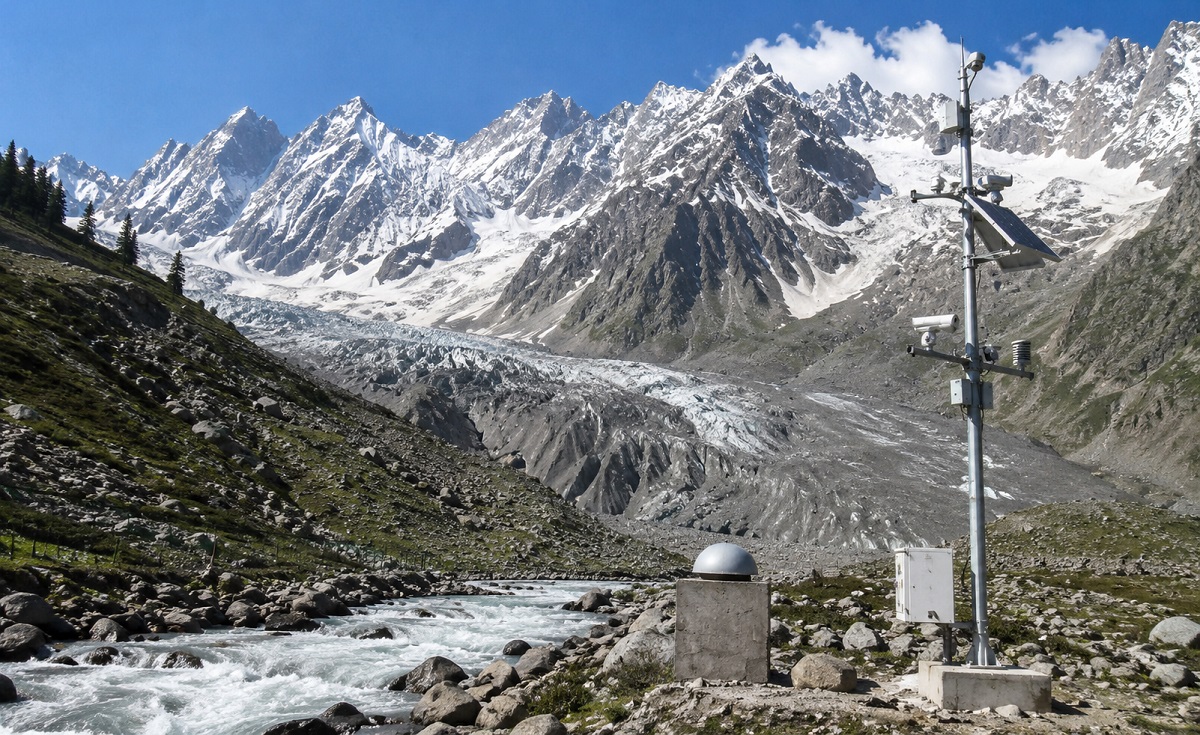
The glaciers feeding the Upper Indus Basin have shrunk by more than 30 percent over the past six decades, and the retreat is speeding up, scientists told a conference at the Islamic University of Science and Technology on Tuesday.
The figure came from the varsity’s vice chancellor, Prof. Shakil Ahmad Romshoo, who addressed the second day of a four-day international conference on nature-based solutions for climate resilience in the Himalayas.
Standing before an audience of researchers and policymakers, he described a cryosphere in retreat and a hydrological system on the edge of transformation.
“We have lost over 30 percent of the glacier mass during the last six decades, but even more glacier mass is predicted to disappear by the end of the 21st century,” Romshoo said.
His presentation traced how rising temperatures have altered snowfall patterns, glacier volume, and river flow throughout Kashmir and Jammu, and what those changes could mean for millions who depend on Himalayan meltwater for drinking supplies, irrigation, and hydropower.
The projections extended decades forward, sketching a future in which the region’s water security depends increasingly on how quickly adaptation strategies take hold.
That theme carried into the conference’s keynote address, delivered remotely by Dr. Jagvir Singh, a scientist with the Ministry of Earth Sciences.
Singh laid out the ministry’s mandate and its major scientific missions, then turned to a statistic that framed the day’s proceedings: global temperatures have climbed from 2.2 to 2.35 degrees Celsius above preindustrial levels, according to recent estimates.
Two glacial hundredths of a degree may sound small, but scientists in the room understood it as confirmation that the pace of change keeps outstripping earlier forecasts.
The afternoon sessions moved from atmospheric data to ecological mechanics.
Researchers presented findings on carbon and nitrogen cycling in shifting environmental conditions, examining how these fundamental processes respond as temperatures climb and precipitation patterns change.
Another set of talks focused on wetlands, framing them as a first line of defense against flooding: natural systems that absorb and slow rising waters before they reach vulnerable communities downstream.
What united the presentations was a shared premise: technology alone cannot solve what centuries of ecological function once managed on its own.
Speakers argued that restoring and protecting wetlands, forests, and glacial watersheds gives regions like Kashmir a buffer against extremes that engineering solutions alone often fail to replicate.
An interactive question session closed the day, with attendees pressing scientists on implementation: how policy might translate models and projections into protections on the ground.
Outside the conference hall, the numbers Romshoo cited held impact beyond academic circles.
Kashmir rivers begin as ice, and when that ice disappears faster than expected, farmers, cities, and power grids downstream feel the consequences way before any policy catches up.
The conference continues through its remaining two days, with sessions expected to focus on translating the science presented this week into strategies communities can act on before the glaciers retreat further.
This article has been automatically published using a syndicated feed. The content is sourced externally and may not have been reviewed by The Freelancers Team.