



By Mohammad Arfat Wani
A disturbing design has settled into educational life in Kashmir and far beyond it.
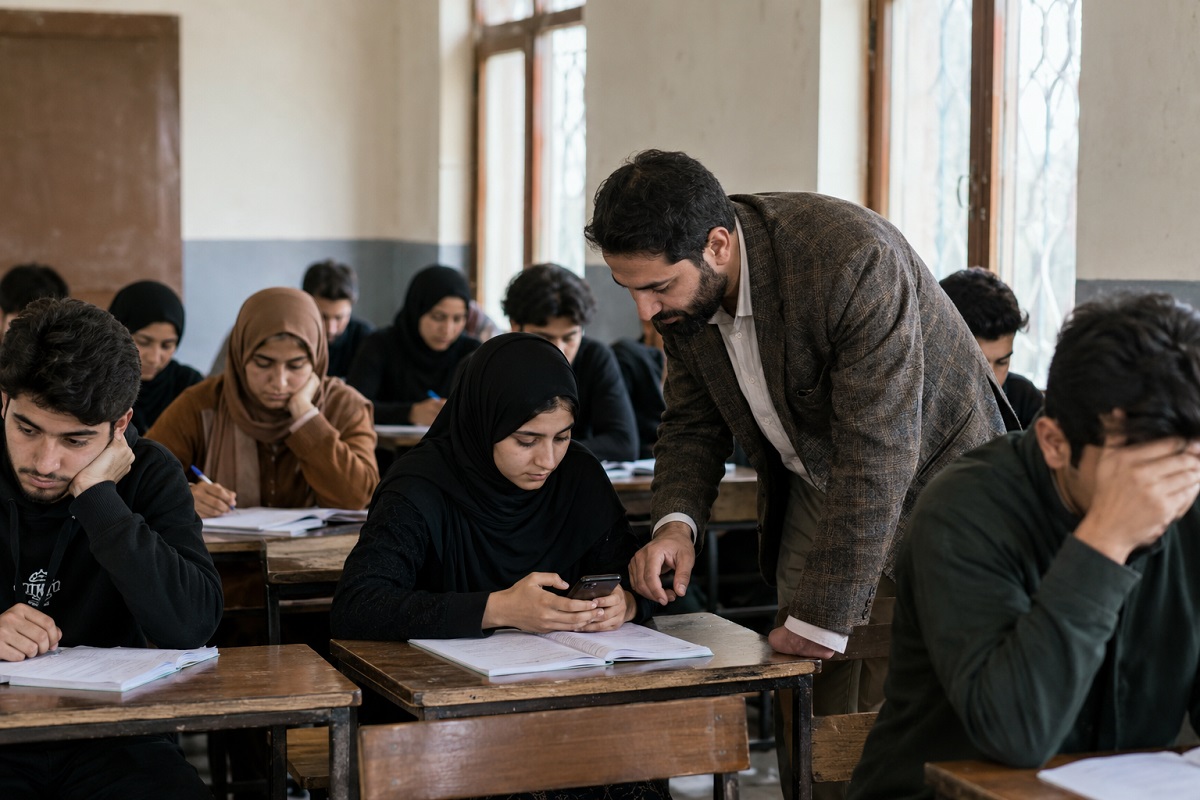
Hardly a week passes without reports of harassment inside campuses, leaked chats between students and teachers, emotional manipulation through social media, drug abuse inside colleges, or public scandals that leave institutions scrambling to protect their image.
These controversies spark outrage for a few days, then disappear into the noise of the next one. The deeper crisis keeps growing.
Educational institutions once stood as places where young people learned discipline, restraint, character, and intellectual seriousness. Teachers occupied a position that commanded respect because society viewed them as custodians of judgment and moral clarity. Classrooms cultivated habits that prepared students for public life and personal responsibility.
That foundation has weakened under the pressure of a culture driven by digital exposure and emotional excess.
Smartphones and social media transformed the emotional world of young people within a single generation. Students now grow up inside a system built around instant attention, constant comparison, and algorithm-driven validation.
Every emotion seeks expression, and each interaction demands visibility.
Private experiences turn public within seconds. Digital life rewards impulsive behaviour and emotional display far more than patience, maturity, or restraint.
Many students spend hours online every day while experiencing profound emotional isolation in their real lives. Endless digital interaction created a strange form of loneliness where people remain permanently connected and emotionally detached at the same time. Educational institutions still operate as if this psychological transformation never happened.
Schools, colleges, universities, and coaching centers continue focusing almost entirely on examinations, grades, placements, rankings, and institutional branding. Emotional literacy receives little attention. Ethical conduct receives ceremonial speeches instead of serious engagement. Counseling systems remain weak despite rising anxiety and emotional instability among students.
This gap between institutional culture and social reality created dangerous consequences inside classrooms.
Communication between teachers and students once remained confined to academic settings. Digital culture erased those boundaries. Conversations now continue through messaging apps, social media platforms, video calls, and private chats at every hour of the day. Familiarity deepens quickly inside these spaces because digital communication encourages emotional dependence and personal disclosure.
Every interaction may begin innocently. Emotional closeness gradually develops through constant accessibility. Professional distance weakens, favouritism enters the picture, secrets emerge, emotional dependency grows stronger, and ethical judgment loses clarity.
Educational spaces then become vulnerable to manipulation, exploitation, and public scandal.
Social media intensified this collapse of boundaries. Screenshots circulate within minutes. Rumours spread faster than facts. Edited videos destroy reputations overnight. Public outrage now functions as instant punishment even before any investigation begins.
Teachers and students both live under constant emotional exposure and public suspicion.
Teachers themselves face enormous pressure inside this environment. Earlier generations associated teaching with prestige, authority, and moral influence. Many educators today work under fear of accusations, online humiliation, administrative pressure, and public backlash. Classroom discipline itself became controversial in many institutions because every disagreement risks escalation into digital controversy.
Authority weakened gradually as educational spaces lost their ethical center.
Campus culture also changed under the influence of celebrity lifestyles, algorithm-driven entertainment, and addictive digital consumption. Vaping, drug use, violence, and compulsive dependence on screens have entered many educational environments around the world. Attention spans continue shrinking while emotional volatility continues rising. Popular culture now teaches students more about relationships, identity, and behaviour than families or institutions ever could.
Families themselves struggle under economic pressure, emotional exhaustion, fractured communication, and excessive screen dependence. Parents spend less time guiding children through emotional and moral development. Social media influencers now occupy a larger role in shaping attitudes than elders, teachers, or community leaders.
Commercialized education deepened the crisis further.
Many institutions chase rankings, infrastructure, marketing campaigns, and admissions growth while treating emotional development as secondary. Students graduate with technical qualifications and professional ambitions while lacking emotional maturity, ethical discipline, and psychological stability.
This reality deserves honest discussion without descending into moral panic or blanket condemnation.
Countless teachers continue serving students with sincerity, professionalism, and personal sacrifice despite difficult working conditions. Millions of students still approach education with seriousness, humility, and genuine commitment. Their efforts deserve recognition because they preserve the remaining credibility of educational life.
Still, society cannot ignore the larger deterioration taking place inside classrooms and campuses.
Educational decline never begins with falling grades alone. Civilizations weaken when respect disappears from human interaction, when emotional restraint loses value, and when knowledge separates itself from wisdom. A society suffers profound damage when institutions produce intelligent individuals who lack ethical judgment and self-control.
History offers countless examples of teacher-student relationships that produced philosophers, scientists, reformers, physicians, poets, and visionaries whose work advanced human civilization. Those relationships succeeded because they rested upon discipline, ethical seriousness, intellectual rigour, and mutual respect.
Modern education increasingly struggles to preserve those foundations.
Technological advancement continues accelerating at astonishing speed. Human beings possess greater access to information than any previous generation in history. That progress means little when emotional instability, moral confusion, and compulsive digital behaviour dominate educational culture. Societies flourish through wisdom, restraint, and ethical clarity as much as through innovation and technical skill.
Kashmir understands the value of education deeply because generations treated learning as a path toward refinement of intellect and character. That tradition needs protection before emotional excess and digital chaos consume what remains of institutional credibility.
Classrooms need knowledge, young people require guidance, and society needs moral seriousness. Educational institutions that fail to defend those principles risk producing generations equipped for professional success and utterly unprepared for responsible human conduct.
That contradiction threatens the future far more than any technological disruption ever will.
- The author is a social activist and nursing student from Kuchmulla, Tral. He can be reached at [email protected].
This article has been automatically published using a syndicated feed. The content is sourced externally and may not have been reviewed by The Freelancers Team.