


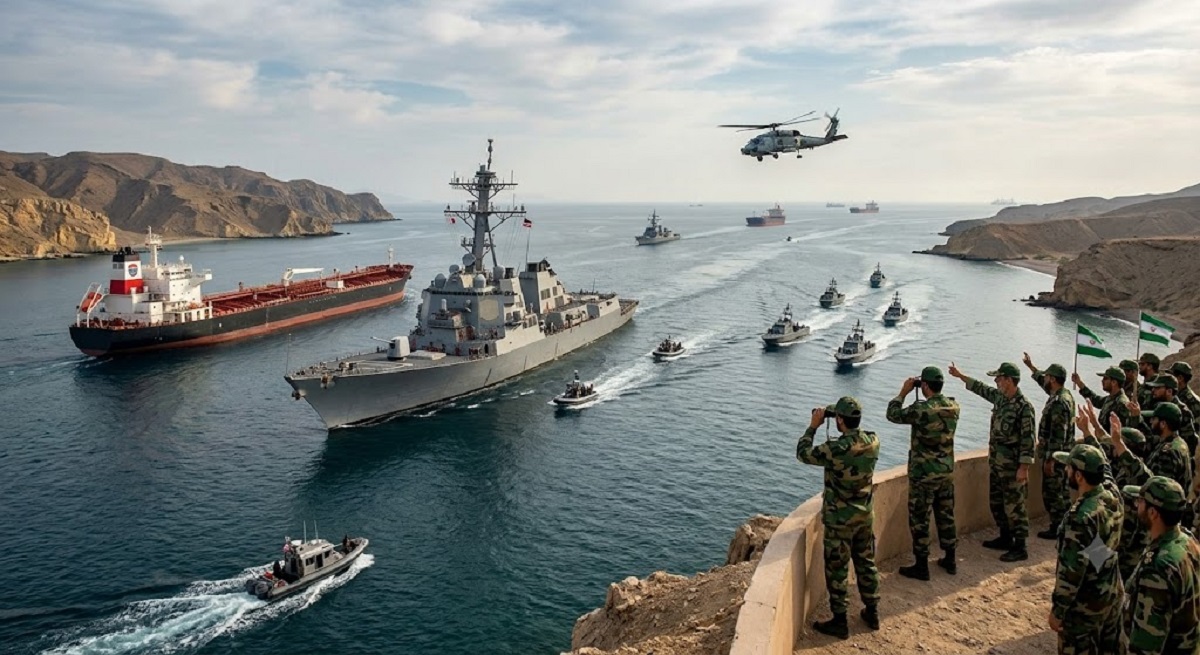
Washington/Tehran- US President Donald Trump on Monday announced that Washington was “reinstating” a blockade on Iranian shipping in the Strait of Hormuz and would impose a 20 per cent toll on eligible cargo using the strategic waterway, prompting Tehran to issue a blunt warning that any American attempt to interfere in the management of the strait would be treated as an assault on Iran’s sovereignty and could ignite a wider regional conflict.
The renewed war of words came amid another round of military exchanges in the Gulf, casting fresh doubt over ongoing negotiations aimed at reaching a permanent settlement to the conflict that erupted after the US and Israel launched military action against Iran on February 28.
“Following previous warnings, we will under no circumstances allow the United States to interfere in the management of the Strait of Hormuz,” Lieutenant-Colonel Ebrahim Zolfaqari, spokesman for Iran’s Khatam al-Anbiya Central Headquarters, said in a statement.
Describing Washington’s actions as “adventurism and mischief”, Zolfaqari said the US had seriously endangered regional security, international trade and the movement of oil tankers and commercial vessels.
He warned that any regional country providing logistical or military support to US operations would be considered to have entered the conflict.
“Any cooperation with the United States and logistical support for that country’s aggressor army will be regarded as war against Iran’s sovereignty and national security,” he said.
“If war expands in the region, the flames of fire will engulf all regional countries,” he added, placing responsibility for any escalation on the United States and governments cooperating with it.
Zolfaqari also said Iran’s armed forces would “firmly confront” any attempt by the US military to escort commercial ships or oil tankers outside maritime routes designated by Tehran, saying recent operations by the Islamic Revolution Guards Corps (IRGC) and the Iranian Army demonstrated the country’s resolve.
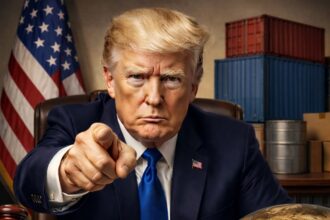
Trump announced the new measures in a series of posts on social media, declaring that the United States was restoring what he called the “Iranian Blockade”, under which Iranian ships and vessels serving Iranian customers would be prevented from entering or leaving the Strait of Hormuz.
“We are reinstating THE IRANIAN BLOCKADE, so named because it is only stopping Iran’s ships or customers from entering or leaving. All other countries will have fair and open use of the Strait,” Trump wrote.
He also announced that Washington would levy a 20 per cent toll on eligible cargo passing through the waterway, saying the revenue would help cover “any and all costs necessary to do the job of providing safety and security to this very volatile section of the World.”
Later, during a telephone interview with Fox News’ Fox & Friends, Trump suggested the United States could assume operational control of the strategic passage.
“We’re going to keep the strait, and we’ll probably run it. We’ll become the guardian of the strait. Maybe we’ll call it the guardian angel of the strait. And we should be reimbursed for that,” he said.
The latest escalation followed an Iranian attack on a container ship on Sunday after it attempted to bypass routes designated by Tehran in the Strait of Hormuz. Iran has maintained that it assumed operational control over traffic in the strategic waterway after the outbreak of the war and has the authority to regulate shipping under an interim peace arrangement reached with Washington last month.
The United States and several Western allies dispute Tehran’s interpretation, arguing that freedom of navigation through the strait is guaranteed under international law. Washington has been attempting to establish alternative shipping corridors outside Iranian control.
Iran’s position was reinforced by the IRGC, whose spokesman Brigadier General Hossein Mohebi warned that Tehran would respond more forcefully to what he described as continued American aggression.
“Just as we reduced the delusional ambitions of America’s ringleaders at the outset of their aggression to the mere reopening of the Strait of Hormuz, in their latest villainy we will drag them into greater humiliation and desperation than ever before,” Mohebi wrote on X.
In a separate post, he said the United States should be held responsible for threatening global energy security by intervening in the strategic waterway.
“We continue to assert sovereignty and management over the Strait of Hormuz with full strength and power, and we will compel foreigners and their allies to submit to the will of the Iranian nation,” he said.
Meanwhile, the Persian Gulf Strait Authority (PGSA) said on Sunday that transit through the Strait of Hormuz had been suspended following what it described as “unlawful movements” by US military forces in the region.
“Due to recent unlawful movements by United States military forces in the region, transit through the Strait of Hormuz is currently not possible,” the authority said in a statement posted on X.
The latest developments have further complicated negotiations between Tehran and Washington, which are nearly halfway through a 60-day timetable agreed under a Pakistan-brokered Memorandum of Understanding (MoU) signed on June 17 to negotiate a permanent end to the war and resolve disputes over Iran’s nuclear programme. Tehran maintains that Article 5 of the agreement entrusts Iran with responsibility for reopening and managing the Strait of Hormuz, a claim rejected by the United States.
The renewed tensions rattled global energy markets, with oil prices climbing nearly five per cent in early trading before easing later in the day. US benchmark crude, which had surged to nearly USD 120 a barrel at the height of the conflict, was trading around USD 72.92 by Monday afternoon.
The Strait of Hormuz, through which roughly one-fifth of global oil and gas supplies normally pass, remains one of the world’s most strategically important maritime chokepoints, and the latest confrontation has revived fears of a broader regional conflict and renewed disruption to global energy supplies.
US-allied Arab states report another wave of attacks
Sirens sounded in Bahrain, home to the US Navy’s 5th Fleet, and Kuwait as volley of Iranian missiles targetted US military bases across the region.
In Jordan, the kingdom’s military said it shot down a number of Iranian missiles aimed at US military bases.
Early on Sunday, the US military said it hit some 140 targets, including missile and drone launch sites, ammunition dumps and communication equipment — a far-heavier set of attacks than in two previous rounds of strikes in the last week.
Iran retaliated by attacking nations in the region hosting US military forces.
Sunday’s attacks stretched to Bahrain, Kuwait, Qatar, Jordan and even Oman, which shares the strait with Iran.
Iran’s chokehold on the strait has loosened as the US military supports vessels moving along a southern route hugging the coastline of Oman. That new route has angered Iran, which has launched repeated attacks on ships using it.
Traffic through the Oman route dropped over the weekend to minimal levels, indicating that operators continue to prioritise perceived security over more direct transit options,” the ship-tracking website MarineTraffic.com said.
Iran’s Foreign Ministry spokesperson Esmail Baghaei blamed Washington for the chaos gripping the region.
“Considering the memorandum of understanding’s fourteen clauses, the Americans have, in this brief period, in one way or another, slaughtered its various components,” Baghaei told journalists Monday.
This article has been automatically published using a syndicated feed. The content is sourced externally and may not have been reviewed by The Freelancers Team.