



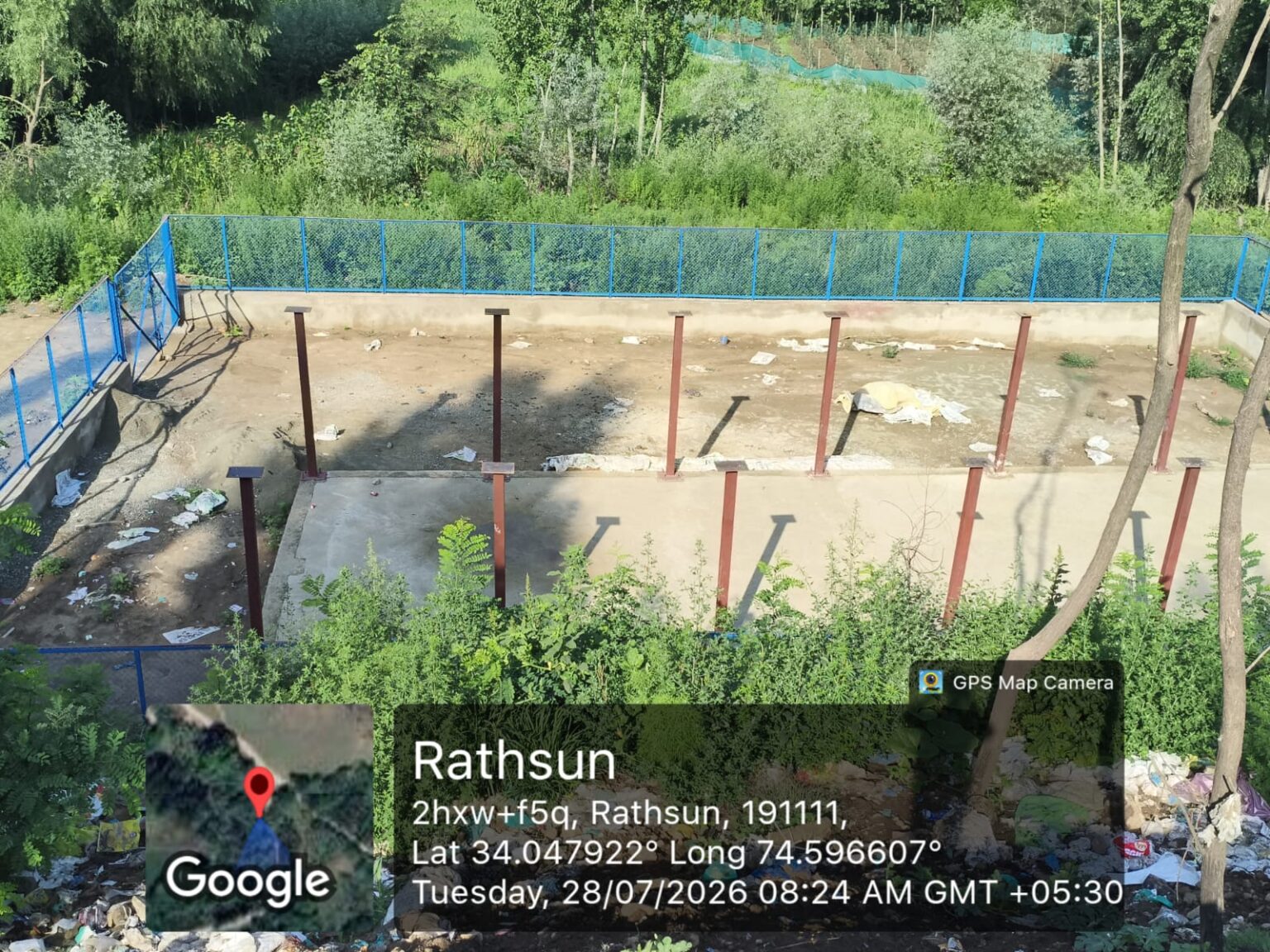
The trucks came after dark. Villagers in Ohangam, a small settlement in Beerwah tehsil, watched headlights swing into the construction site sometime after midnight on July 27, as workers began pouring material into the ground under floodlights that had no business burning at that hour.
By sunrise, everyone in the village knew what had happened.
The waste management plant residents believed they had halted had been built overnight, while the district slept.
“The entire material was dumped here at the site and full night work was taken up,” said Fayaz Ahmad, a resident of Ohangam who watched the construction unfold.
His account, and those of his neighbours, point to a decision by the Rural Development Department to press ahead with a project that the Jammu and Kashmir Pollution Control Committee had already flagged as unlawful.
The dispute traces back to a written complaint filed on June 5 by Dr. Raja Muzaffar Bhat, who chairs the J&K Climate Action Group.
Bhat asked the Pollution Control Committee to examine the Ohangam site, and the committee’s divisional office in Budgam sent an inspector within days.
What that inspector found, laid out in a report dated June 11, described a location almost perfectly wrong for its intended purpose.
The report placed the site roughly 125 meters from a school and 200 meters from human habitation, with the nearest house standing just 120 meters away. Orchards surrounded it on every side.
Waste, the inspector wrote, was already being dumped along the roadside of the Ohangam-Rathsun-Soibugh road, a route that links several villages and carries daily traffic.
Stray dogs roamed the grounds, drawn by the smell, and the inspector warned they posed a risk to children walking to and from school.
The odour itself had become strong enough to make the road difficult to use, the report said, creating what officials termed a public nuisance.
Armed with those findings, the Regional Director of the Pollution Control Committee issued a formal notice on July 6 to the Assistant Commissioner Panchayat in Budgam and the Block Development Officer in Rathsun, demanding they explain why legal action should be withheld.
The notice gave both officials 15 days to respond and instructed them, in direct language, to halt the disposal of waste at the site immediately.
Anything short of a credible response, the notice stated, would make further action all but certain.
That deadline came and went. Instead of a written explanation, residents say they got nighttime construction crews.
Locals now accuse the Block Development Officer’s office in Rathsun and the Assistant Commissioner’s office in Budgam of enabling a project the Pollution Control Committee had explicitly ordered stopped, and doing so by scheduling the work when oversight would be thinnest.
The episode lands amid a broader design across Jammu and Kashmir, where waste management infrastructure, urgently needed as towns and villages generate more refuse each year, keeps colliding with the Municipal Solid Waste Rules of 2016 and protections under the Water Act of 1974.
Sites meant to solve one problem often create another when they land too close to schools, water bodies, or homes, and Ohangam appears to fit that pattern closely: canals for irrigation border it, a school sits nearby, and the surrounding land is planted with orchards that feed local households.
Bhat, whose original complaint set the process in motion, said he raised the nighttime construction directly with the Regional Director, Safeer Hussain, and came away with a promise of consequences.
“The official assured me to take stringent action against the culprits including the RDD contractor,” Bhat said.
The activist framed the dispute in blunt terms, describing a public space surrounded by water, a school, and orchards, and accusing the Rural Development Department of pushing to spend allocated funds regardless of the legal cost.
Bhat said he intends to bring the case before the National Green Tribunal and will seek compensation on behalf of the Ohangam panchayat.
What happens next will test whether a written notice from a pollution regulator carries any real weight against a department determined to finish what it started.
For the families living within a few hundred meters of the site, the question is not abstract.
It is the smell on their road, the stray dogs near their children’s school, and the fear that construction finished under cover of night will prove far harder to undo in daylight.
This article has been automatically published using a syndicated feed. The content is sourced externally and may not have been reviewed by The Freelancers Team.