



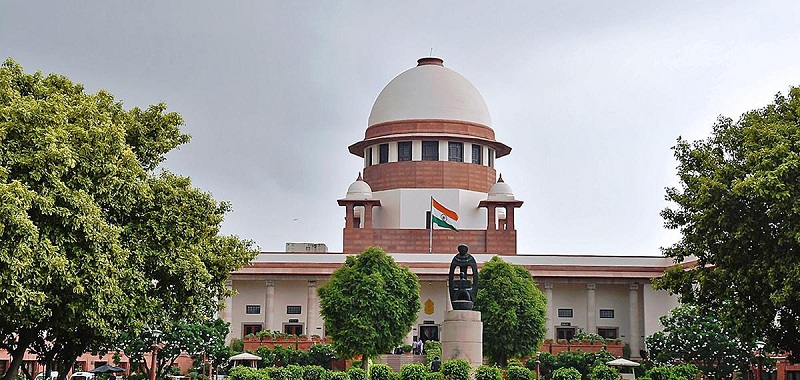
New Delhi- The Supreme Court on Monday sought responses from the Centre and others on a plea seeking directions to strengthen the fight against drug trafficking, including a time-bound probe and trial of narcotics cases, confiscation of properties of traffickers and creation of a uniform investigation protocol.
Observing that the problem is “very serious”, a bench of Chief Justice Surya Kant and Justices Joymalya Bagchi and V Mohana said coordinated efforts by expert agencies were required to deal with the menace.
Advocate Ashwini Kumar Upadhyay, who has filed the petition, told the bench that a similar issue is already pending before the apex court.
“The problem is very serious,” the bench observed, adding that some kind of a solution has to be there by the expert agencies.
Upadhyay said some of the countries, including Singapore, have taken several effective steps to deal with the problem of drug trafficking.
The plea, filed through advocate Ashwani Kumar Dubey, has sought directions to the Centre and states to prescribe mandatory timelines for the submission of forensic reports in cases under the Narcotic Drugs and Psychotropic Substances (NDPS) Act and frame standard operating procedures (SOPs) for search, seizure and sampling of narcotic substances.
It also sought a direction to the Centre to frame SOP for time-bound investigation and speedy trial in such cases.
“Keeping in view the menace of drug mafia network operating in India, the court may be pleased to issue a writ, order or direction to, a) direct the Centre and state governments to prescribe a mandatory timeline for submission of FSL (forensic science laboratory) reports in all NDPS cases; b) direct the Centre and states to formulate a SOP for search, seizure and sampling in small and intermediate quantity cases,” the plea said.
It also sought the constitution of special courts for speedy trial of the NDPS cases and implementation of mandatory digital recording and videography of search, seizure and sampling proceedings.
Claiming that drug abuse and trafficking had assumed alarming proportions, the plea said there was a 53 per cent rise in drug cases in 2025, and 1,240 tonnes of narcotic substances were seized during the year, indicating the growing scale of the problem.
It referred to incidents from Punjab and other states to argue that drug addiction was destroying families and affecting public health and law and order.
The plea claimed the existing framework lacked uniform investigation standards, time-bound forensic examination and effective coordination among enforcement agencies, leading to delays in prosecution and avoidable acquittals.
Seeking stricter action against organised drug syndicates, the plea urged the court to direct authorities to carry out time-bound assessment and confiscation of properties of traffickers, financiers and their family members under the NDPS Act, Prevention of Money Laundering Act, Benami Property Act and Black Money Act.
The plea further sought directions for creation of an expert committee to identify and regulate new psychoactive substances, establishment of rehabilitation and wellness centres for addicts and formulation of a graded sentencing policy that distinguishes traffickers and financiers from addicts and personal-use offenders.
The petitioner has also sought a direction to the Law Commission to prepare a comprehensive report on the issue and a declaration that sentences in NDPS cases should run consecutively.
This article has been automatically published using a syndicated feed. The content is sourced externally and may not have been reviewed by The Freelancers Team.