


By Farooq Ahmad Khan
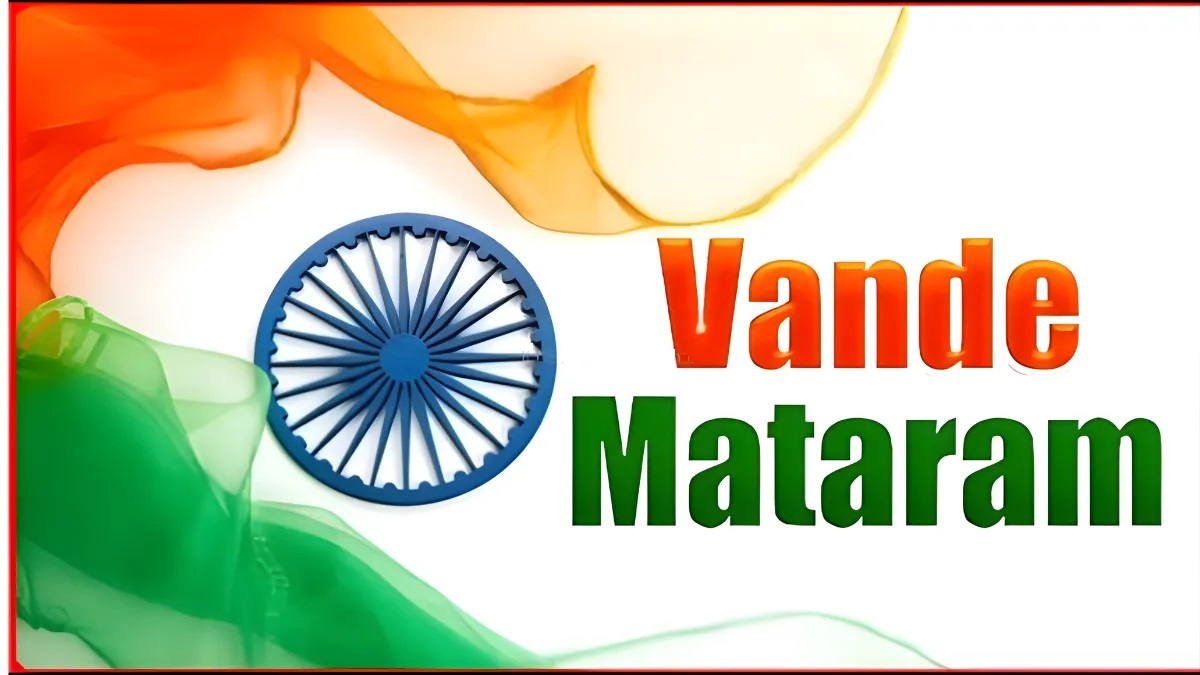
Bankim Chandra Chattopadhyay’s Vande Mataram grew far beyond the novel in which it first appeared, becoming a powerful voice of the freedom struggle and a lasting part of the country’s collective memory.
As a song that belongs to the whole nation, the question of which version Indians should sing together calls for accommodation rather than religious or political assertion.
The Congress Working Committee reached that answer once already, in 1937.
Objections had come in about parts of the poem, and the committee drew a line inside it.
The opening two stanzas describe the motherland through rivers, harvests, breezes and moonlight, images any citizen can embrace without hesitation. The stanzas that come after move into different territory, addressing the country through the figures of Hindu goddesses.
The committee’s solution was to confine national renditions to the first two stanzas.
Rabindranath Tagore, who gave the poem its tune, recognized the same divide. None of this insulted Bankim or diminished the poem. It simply acknowledged that India holds more than one faith inside it.
On 24 January 1950, Rajendra Prasad brought that settlement into the Constituent Assembly itself, declaring that Vande Mataram would stand equal in honour to Jana Gana Mana because of the part it had played in winning independence.
That honour rested on what the country could sing together, rather than on forcing agreement with all of the poem’s imagery.
A recent move toward reciting the full six-stanza version at official occasions has reopened a settlement that had held for decades.
The question raised by that move goes beyond who loves the song more fiercely. It asks what a national song may fairly ask of the person singing it.
Love of the country, and nothing beyond that, seems the only defensible answer.
A Muslim citizen should not have to voice Hindu religious imagery to prove that love. A Hindu citizen should not be expected to voice a line from another patriotic work if he reasonably hears in it a celebration of conquest.
The principle has to run in both directions or it is not a principle at all.
Muhammad Iqbal’s Tarana-e-Hindi, known everywhere by its first line, Sare jahan se achha Hindostan hamara, holds one of the clearest statements of shared belonging ever written in Urdu: religion teaches no hostility between us, we are Indians, and Hindustan is our homeland.
Millions sing those words without a second thought.
The same poem contains a stanza addressed to the Ganga, asking whether the river remembers the day “our caravan” came down to its banks.
Iqbal never says who travelled in that caravan. Some readers hear in the line an echo of invasion, but the evidence leaves the poet’s meaning open to interpretation.
Treating one reading as settled fact risks putting words into the bard’s mouth.
But the uncertainty itself teaches something useful. If a Hindu reader hears an old wound in those words and would rather leave them out of a rendition sung by everyone, the poem loses nothing by the omission.
It remains whole in the book, while being spared the burden of speaking for people it was never written to represent.
Apply that same reasoning to Vande Mataram and the current dispute resolves itself without anyone surrendering anything genuine.
Sing the first two stanzas together, as settled in 1937 and confirmed in 1950. Where Tarana-e-Hindi is sung as a shared anthem, sing the stanzas that hold everyone rather than the one that unsettles some.
Bankim’s complete work stays untouched in libraries and literary history. Iqbal’s does too. A poem belongs entirely to the poet who wrote it. A national rendition belongs to the nation that sings it, and the nation is entitled to choose which parts it sings in common.
India has no shortage of people willing to love their country. What needs watching is the temptation to turn that love into a test, with one citizen deciding which words prove another’s loyalty.
A Hindu who accepts a Muslim’s unease with devotional verses loses nothing of his own belief. A Muslim who accepts a Hindu’s unease with a line that might recall conquest loses nothing of his.
Both walk away with a firmer, shared claim on the same country.
National symbols grow strongest through voluntary embrace, rather than through instructions about which verses to sing on command.
Let the complete Vande Mataram remain Bankim’s, and the complete Tarana-e-Hindi remain Iqbal’s, safe on the page exactly as written. When citizens of different faiths stand together, let them sing what brings them into the same room.
A national song should ask for a citizen’s love. It has no business asking for his faith.
- The author is an advocate practising the High Court of Jammu & Kashmir and Ladakh at Srinagar. He can be reached at [email protected].
This article has been automatically published using a syndicated feed. The content is sourced externally and may not have been reviewed by The Freelancers Team.