



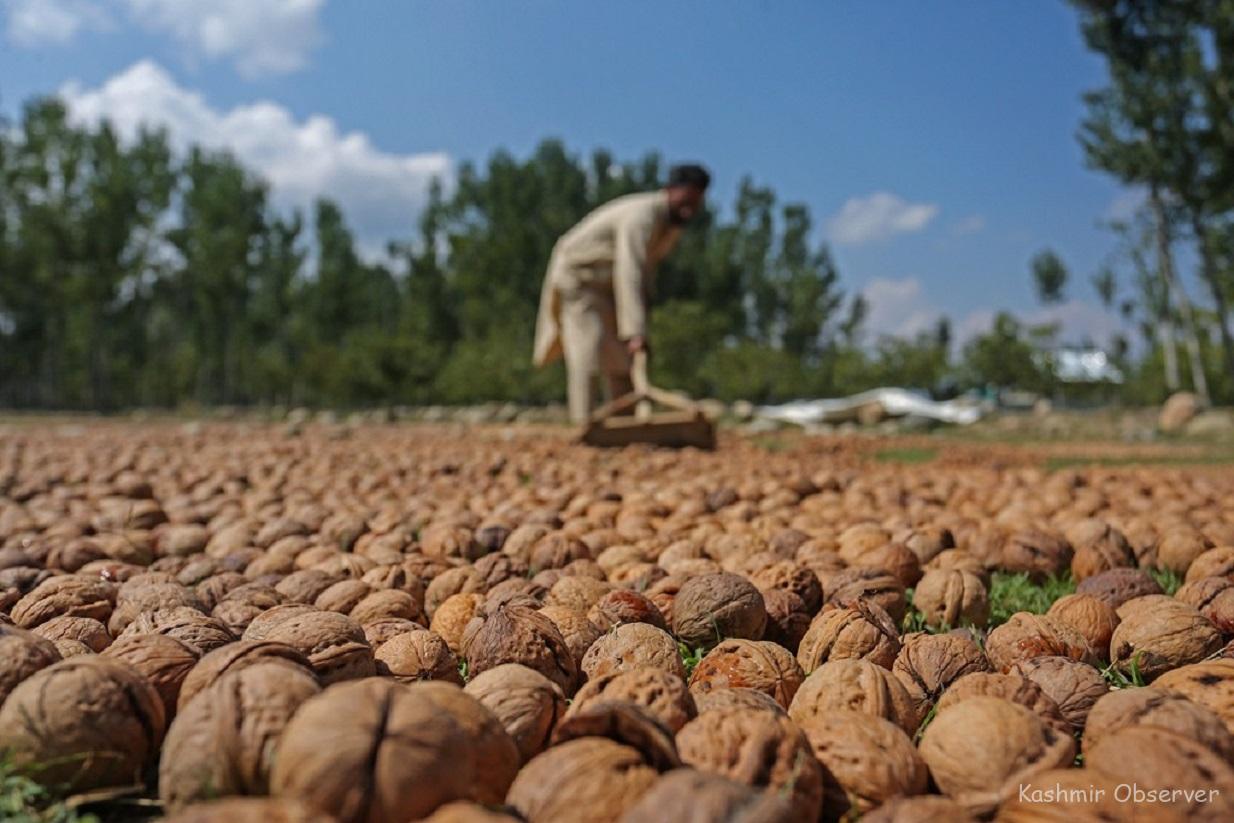
Ask a farmer in Kulgam what a walnut tree means to him, and he is unlikely to describe it as a crop.
It is closer to a bank account with roots.
A walnut tree takes years to mature, gives little at first and then produces for decades.
Its earnings have paid school fees, hospital bills, roof repairs and weddings. When walnut prices fall, therefore, a family’s income does not simply shrink for one season. One of its most dependable forms of savings loses value.
The numbers show how badly this sector is being underused.
According to NITI Aayog’s 2026 horticulture roadmap, based on FAOSTAT and government data, India accounted for 7.97 percent of global walnut production in 2023-24. Jammu and Kashmir alone contributed 7.70 percent. China led with 35.1 percent and the United States with 18.74 percent.
J&K does not have to outproduce China or the United States. Its opportunity lies elsewhere: better kernels, stronger quality controls, traceable Himalayan origin and packaging that turns a commodity into a recognisable product.
The difference between production and exports is striking. India produced 322,089 metric tonnes of walnuts in 2024-25 across 96,680 hectares, according to APEDA and the National Horticulture Board. But exports in 2025-26 stood at only 1,139.07 metric tonnes, worth $8.44 million.
That is roughly 0.35 percent of national production.
The export trend makes the problem harder to ignore. Volumes fell from 2,482.56 metric tonnes in 2021-22, worth ₹73.98 crore, to 638.07 metric tonnes in 2023-24, worth ₹20.02 crore.
In two years, export volume fell by about 74 percent and export value by nearly 73 percent.
The harvest consequently remains heavily dependent on domestic markets.
When more walnuts stay within Kashmir, local prices come under pressure. Lower returns leave farmers with less money for pruning, manure, improved saplings and orchard maintenance.
That creates a common economic trap: weaker prices reduce investment, weaker investment affects future productivity, and lower productivity makes the crop less competitive.
The orchard itself has problems.
Many trees are old, seed-grown and excessively tall, making harvesting expensive and dangerous. Lighter seasonal rainfall and declining soil quality have also affected production.
Better branding cannot compensate for weak orchard management, but the larger failure comes after harvesting.
Kashmir still sells much of its walnut crop in the shell, as a raw commodity. The greater value lies further down the chain, in cracking, grading, testing, processing, packaging and branding.
A buyer purchasing a clean, labelled packet of kernels is buying more than the nut. The packaging provides information about quality, safety, origin and consistency.
That is where Kashmir is losing ground.
NITI Aayog’s review identifies disparities in processing, quality assurance and market access.
Only 11 percent of registered processing units in J&K are engaged in horticulture processing. For a region producing such a large share of the world’s walnuts, that figure says more than any slogan about horticulture ever could.
The economic opportunity lies in treating the walnut as a product rather than a harvest.
Premium kernels can serve retail markets. Broken kernels can go to bakeries and chocolate manufacturers. Walnut oil can enter food and cosmetic markets. Walnut flour can serve specialised food products. Shells can support craft and industrial uses. Gift packs combining walnuts with saffron and honey can connect the crop to Kashmir’s tourism economy.
That transition does not call for every farmer to buy expensive machinery. Shared processing centres, farmer groups, certified grafted plants, modern drying facilities and reliable quality testing could build the missing middle of the industry.
A common identity such as “Kashmir Walnut, Himalayan Origin” would mean something only if it came with verifiable standards and traceability.
The Union government’s 2026-27 Budget has proposed support for high-value crops, including high-density walnut, almond and pine-nut cultivation and the rejuvenation of old, low-yield orchards in hill areas.
The test will come on the ground, in places such as Kulgam, Anantnag, Shopian, Pulwama, Budgam, Kupwara and the hill districts of Jammu.
A budgetary allocation becomes meaningful only when it reaches the orchard as a grafted sapling, a drying facility, a processing centre or a better price.
The stakes are larger than horticulture statistics suggest.
For a farming household, the walnut harvest is a yearly cash flow built on an investment that can take years to mature. When that income weakens, household savings weaken with it. So does the money available for education, emergencies and orchard maintenance.
Kashmir already has the trees, the climate, the production base and a globally recognised origin. What it lacks is a value chain capable of turning that natural advantage into durable income.
The trees have done their part for generations. The economic system around them has not.
This article has been automatically published using a syndicated feed. The content is sourced externally and may not have been reviewed by The Freelancers Team.