


Kashmir’s medicinal plants have travelled the world for centuries. Saffron, kahwa blends, dried flowers, herbs, roots, and extracts sourced from the Himalayas often end up in wellness products sold with polished labels and premium pricing in distant markets. Much of that value, however, rarely returns to the region where these resources originate.
That gap sits at the center of Ridha Rashid’s work.
A Srinagar-based scientist trained in analytical chemistry, Rashid belongs to a younger generation in Kashmir trying to connect research, entrepreneurship, and local industry in ways that feel practical rather than symbolic.
Her company, Hamdan Herbs, supplies medicinal plants and herbal raw materials to pharmaceutical and nutraceutical companies while pushing for something larger: a system where Kashmir participates as a supplier of raw material, as well as a center for processing, research, branding, and product development.
Her journey has moved through laboratories, classrooms, trade networks, artisan collaborations, and now the growing wellness industry.
Trained at SNDT Women’s University and currently pursuing a PhD at the University of Mumbai, Ridha’s academic work explores the pharmacological and anti-cancer properties of medicinal plants. That research eventually pushed her toward a larger question: what is the value of scientific knowledge if it remains disconnected from the place that produces the resource itself?
“Coming back meant choosing uncertainty but also choosing relevance,” she says during the conversation. “I wanted to build something rooted, not just something impressive on paper.”
That idea runs through much of what she does.
Hamdan Herbs grew out of a traditional trading background but moved toward a sector many around her initially struggled to understand. Collecting medicinal herbs and flowers in bulk did not sound like a conventional business plan in a region where entrepreneurship often stays tied to familiar industries.
Ridha stayed with it anyway, convinced that Kashmir’s herbal economy remained underexplored despite growing global demand for natural wellness products.
She speaks with unusual clarity about the difference between branding and authenticity in the wellness market. Words like “natural” and “Himalayan,” she says, have become easy marketing language. Real credibility depends on traceability, sourcing standards, processing, and scientific consistency.
Her work has also moved beyond business.
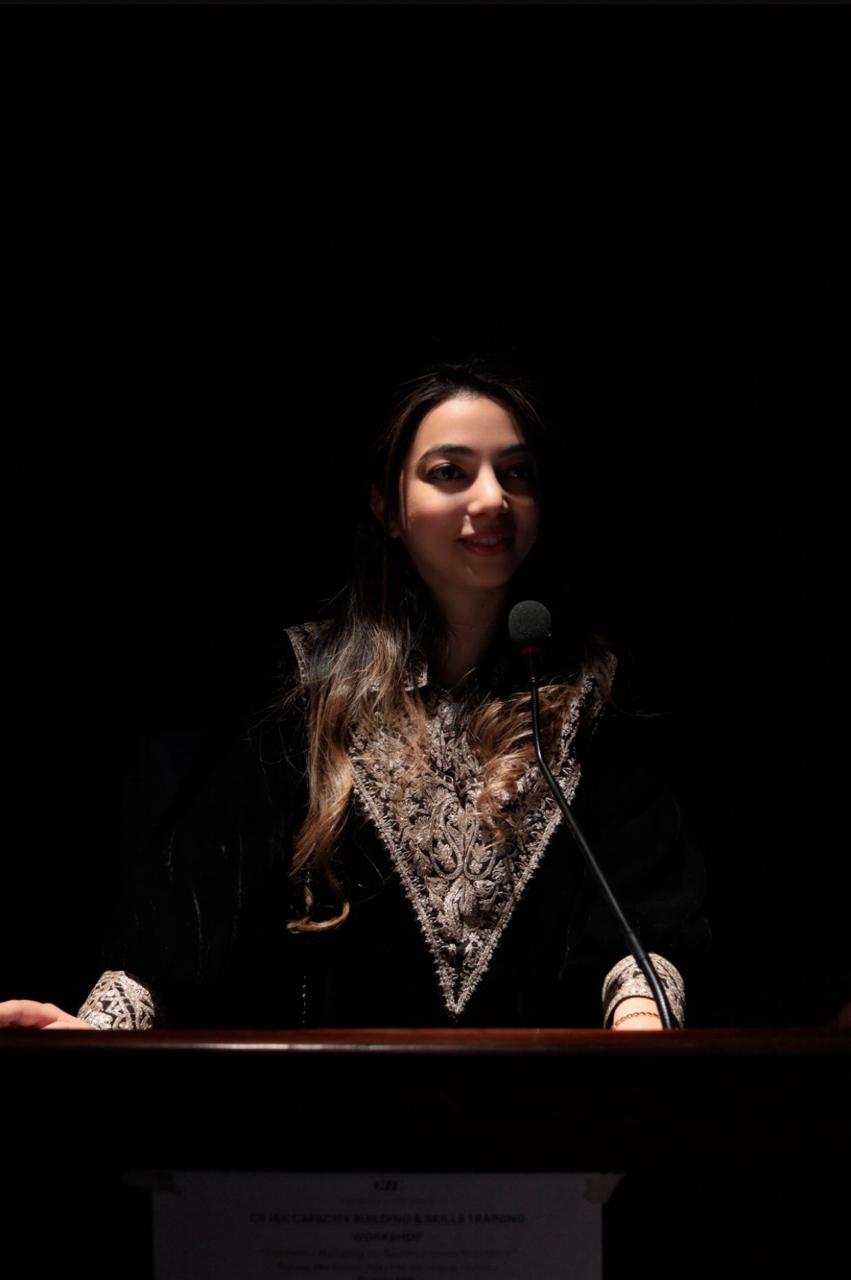
Ridha has authored science textbooks for students, worked with Kashmiri artisans on packaging and market readiness, contributed to tourism capacity-building projects, and recently moderated She Leads, a women’s leadership forum that brought together voices from different professional backgrounds.
Those experiences seem connected by a common instinct: staying close to people and local systems rather than operating from a distance. During the conversation, she returns repeatedly to the idea of contribution, particularly toward Kashmir’s economy and younger generation.
“There are moments when you stop wanting to only study problems,” she says. “You want to participate in solving them.”
At a time when debates around Kashmir increasingly focus on entrepreneurship, local industry, and new markets, Ridha’s story stands out because it sits at the convergence of science and enterprise without losing sight of place. Her ambitions are commercial, but they are also deeply local.
In this candid chat with Kashmir Observer, Ridha Rashid talks about science, family, entrepreneurship, fear, women’s leadership, and why she believes Kashmir can build a serious wellness and medicinal plant economy of its own.
You have a PhD in chemistry underway, run a herbal supply company, and recently moderated a women’s leadership forum. Many people settle into one identity. Did you plan this range, or did life gradually push you toward it?
I never sat down and planned a life with multiple roles. Most of it unfolded naturally because I kept saying yes to opportunities that felt meaningful at the time.
Curiosity has always driven me. Once I learn enough about something, I start asking what more can be done with it in the real world. That instinct pulled me toward research, business, and community work almost simultaneously.
At a deeper level, I also believe life unfolds through a larger plan. We make our own choices, but many important turns arrive unexpectedly.
One thing stayed constant throughout though. I never wanted knowledge to remain confined to theory. Whether through science, entrepreneurship, or social work, I wanted it to become useful in people’s lives.
Tell me about the home you grew up in. What kind of environment shaped your thinking early on?
I grew up in a business family. My father works in wholesale roofing supplies, while my mother managed the home and played a major role in our education.
The atmosphere at home was disciplined but encouraging. Excellence mattered more than prestige. My parents believed even a modest field deserved serious commitment if you chose it.
Money management, responsibility, and consistency became part of our upbringing very early. My mother kept us academically focused, while my father followed our progress through report cards and conversations.
Science entered my life gradually. Nobody ever told me it was unusual or difficult for a girl to pursue it. That freedom itself became encouragement.
Was there a moment when your direction suddenly became clear?
It happened gradually rather than through one dramatic turning point.
Everything changed when I began working closely with medicinal plants. I realized many compounds and therapeutic properties I was studying inside laboratories already existed around me in raw form through Kashmir’s natural resources.
That realization changed my relationship with science. Research stopped feeling abstract and became deeply connected to land, people, and local knowledge.
Academia offered stability and prestige. What made you return to Kashmir instead?
Leaving academia was emotionally difficult because I genuinely valued my time as an Assistant Professor at SNDT Women’s University. I also had supportive mentors who encouraged my work.
At the same time, I always knew I wanted to return home. Family mattered deeply to me and so did belonging.
A larger question also stayed with me. What was the purpose of studying medicinal plants if my work remained disconnected from the place where many of those resources actually come from?
Returning to Kashmir meant choosing uncertainty, but it also gave my work meaning. I wanted to build something rooted in the region instead of only building academic credentials.
Your training spans pharmaceutical analysis, microbiology, and medicinal chemistry. How much of that scientific background still influences Hamdan Herbs today?
Almost every part of the business carries traces of that training.
Science influences how we think about sourcing, quality control, consistency, and documentation. Pharmaceutical and wellness companies work with strict standards, so understanding those systems helps us communicate professionally and build trust.
Even though Hamdan Herbs operates commercially, the mindset behind it remains scientific.
When did you realize you wanted to build something larger around medicinal plants instead of staying only in research?
Kashmir always stayed central to my thinking. I knew early on that I wanted my work to contribute to the local economy in some meaningful way.
When I looked at the medicinal plant sector, I saw both possibility and a clear gap. Kashmir had the resources, but much of the value chain existed elsewhere.
Research helped me understand the problem. Entrepreneurship gave me a way to participate in solving it.
Hamdan Herbs emerged from Hamdan Mercantile. How difficult was it convincing people that herbal sourcing could become a serious business?
Initially, many people struggled to understand the idea. When I spoke about collecting herbs and flowers in bulk, it sounded unconventional to them.
Even inside the family there was hesitation in the beginning, which is natural when someone enters a less familiar industry.
Over time, however, they became my biggest support system. We already had experience in trade through Hamdan Mercantile, so I could see a real opening in the herbal sector.
Once we committed fully, the idea stopped sounding unusual and became a direction with purpose.
The global wellness market constantly uses words like “natural” and “Himalayan.” Do you think those terms still mean anything?
Many times they function more as marketing language than proof of authenticity.
Real credibility comes from traceability. People should know where a product comes from, how it was processed, and who handled it through the supply chain.
Kashmir has enormous potential in this space, but we still largely operate as raw material suppliers. The larger opportunity lies in processing, branding, research, and product development within the region itself.
Many people still doubt whether that scale is possible here. I genuinely believe it is.
You’ve represented your work internationally, including in Dubai. What does it feel like carrying Kashmir onto those platforms?
There’s always a strong sense of responsibility attached to it.
You realize very quickly that you’re representing more than your company or your individual work. You’re also representing an image of Kashmir and what people here are capable of building.
I try to speak about Kashmir with clarity and confidence, especially as a place with skill, knowledge, and entrepreneurial potential.
What is something you had to unlearn during this journey?
Earlier, I cared too much about external validation and how decisions might be perceived by others.
That mindset can slow people down more than they realize. You start delaying decisions because you worry about disappointing people or appearing uncertain.
Eventually I understood that growth sometimes requires difficult choices. Relationships matter deeply, but your direction also matters.
What has been the hardest internal barrier to overcome?
Fear of leaving comfort behind.
At one point I wanted to pursue medicine, but staying close to home felt emotionally important to me and that fear influenced my choices for years.
Moving away for my Master’s degree became a turning point. Once I crossed that barrier, many things changed internally.
That experience taught me something important. Many limitations begin inside us long before they appear outside.
You recently moderated She Leads. What did you learn from creating space for other women instead of speaking about yourself?
Moderating requires a very different kind of attention.
You listen more carefully, observe people more deeply, and think about how to help others express themselves comfortably.
I found the experience deeply meaningful because leadership is not always about visibility. Sometimes it’s about helping other voices come forward more confidently.
You also worked on training material for shikara operators and pony handlers. What did that process teach you?
That project involved direct conversations with operators, guides, and workers connected to tourism on the ground.
We wanted the material to remain practical and rooted in their everyday experiences, especially around communication and customer interaction.
The workshops, including one in Gulmarg, received a very encouraging response. People appreciated being included in a structured effort focused on improving professional skills.
That experience reinforced how much potential already exists within local communities when the right support systems are built around them.
Research, entrepreneurship, consulting, public speaking. Is there one thread connecting everything you do?
I think the thread is responsibility toward Kashmir and toward the people who believed in me.
Much of my work comes from the desire to contribute meaningfully to this place instead of building success disconnected from it.
The vision is still evolving, but contribution remains central to it.
Where do you see yourself and Hamdan Herbs five years from now?
I see Hamdan Herbs evolving into a more structured ecosystem that moves beyond raw supply into processing, formulation, and product development.
I also hope to build stronger collaborations linking Kashmir’s resources with global wellness and pharmaceutical markets in a more meaningful way.
Several ideas are still developing, so I prefer not to speak about everything publicly right now.
What I see very clearly, though, is a stronger team, deeper systems, and the same people who supported the vision standing beside it as it grows.
This article has been automatically published using a syndicated feed. The content is sourced externally and may not have been reviewed by The Freelancers Team.