


‘So… you were convinced of all this and decided not to do anything yourselves?’
‘And decided not to do anything serious,’ Bazarov repeated grimly.
‘But to confine yourselves to abuse?’
‘And that’s called nihilism?’
‘And that is called nihilism,’ Bazarov repeated again, this time with marked insolence. (Fathers and Sons by Ivan Turgenev)
‘So, what did you do in Australia?’
‘Read.’
‘Read what?’
‘Everything I could.’
‘What did it give you? Where’s the degree and the permanent residency?’
‘Knowledge. They did not give me one. No. The whole world is my ken.’
‘What will mere knowledge give you?’
‘A worldview and self-awareness.’
‘Let’s get you married.’
‘No. I am still discovering myself.’
‘You insist on all this?’
‘Totally and absolutely,’ said Javaid to his mother.
‘I will love and support you forever,’ says Javaid’s mother in resignation.
‘Hey, I love you. I can’t even tell you how much. Let’s marry.’
‘I can’t tell you how flattered I am. But I am not romantic anymore. And men… yikes!’ (The emailed response arrives after a while.)
Chagrined and distraught, Javaid says, ‘But we were one, united in sublime love.’
‘But you always talked about and thought of Kashmir. I thought that was your first and last love,’ emails Daniella.
‘You are and shall remain a piece of my heart. I wish you a long, happy life.’
The emailing stops.
Before elaborating upon these vignettes and putting them into context and perspective, a wee digression may be called for.
As US President Donald Trump’s conservative agenda, fostering family and family values, crafting a new social, political, and economic paradigm, and so on, flounders on the rocks of an ill-conceived war against the Islamic Republic of Iran, the entire world is in a tizzy.
While this is politics, it may have a tangential bearing on the other Russian great novelist, Ivan Turgenev.
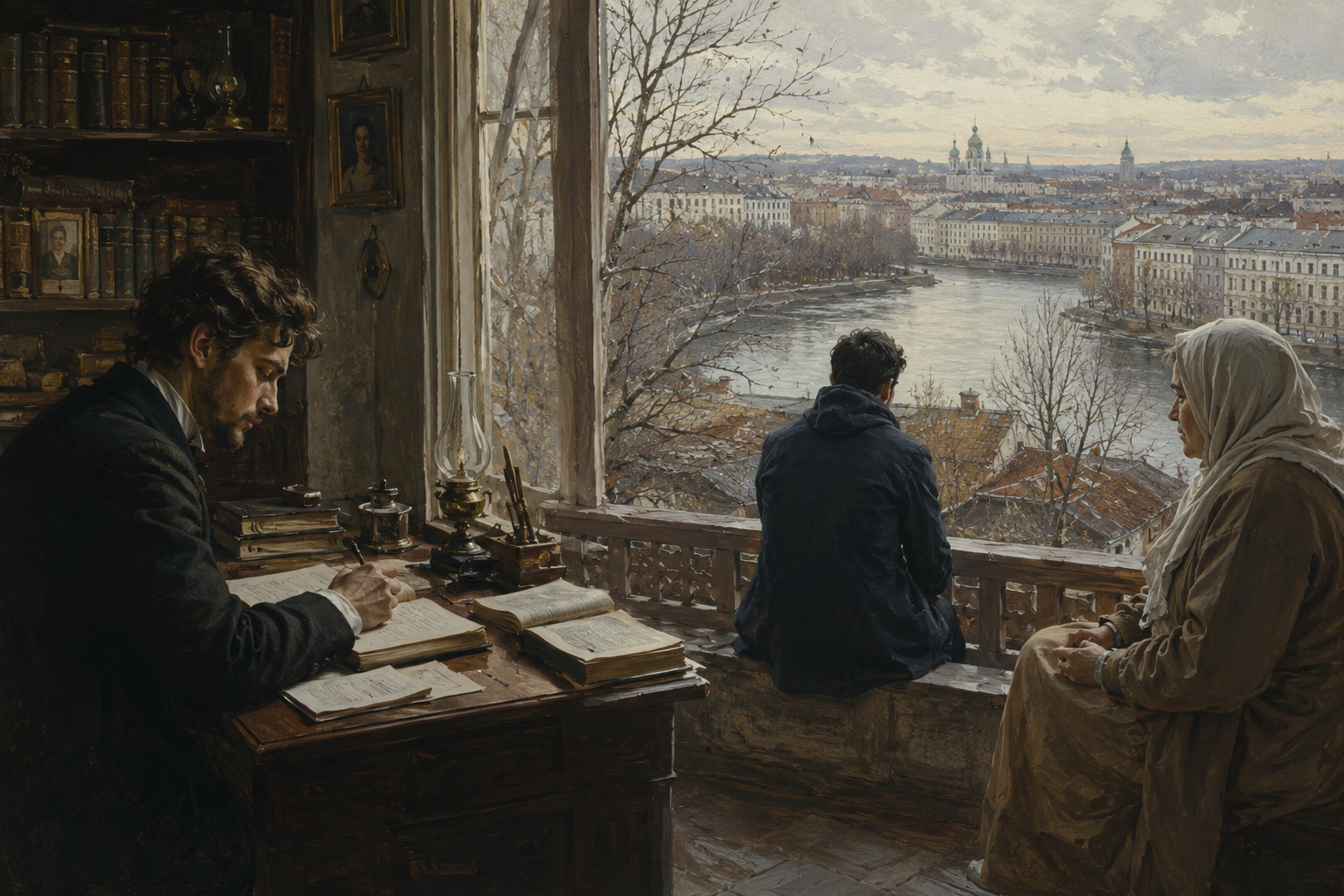
This eminence grise, in his opus, Fathers and Sons, vividly illustrated the tensions and contradictions within Russian families in the nineteenth century.
This was a time when Russia was in the crosshairs of competing ideologies and ideas, European nihilism and liberalism, traditional spirituality and faith, and so on.
Turgenev brought these tensions and contradictions to the fore at his eloquent best.
Highlighting the generational divide in nineteenth-century Russia, Turgenev’s treatise Fathers and Sons tells the story of a young university graduate, Arkady Kirsanov, returning to his father’s estate, Marino. While Nikolai, Arkady’s father, welcomes his son and his friend Yevgeny Bazarov to the estate, his brother Pavel is unsettled by the strange ideology of nihilism that both young men espouse.
After growing bored at the Marino estate, Arkady and Bazarov go to visit Arkady’s relatives. There, both socialize with the locals and end up meeting Madame Anna Odintsova, financially and socially independent and defined by grace and elan, atypical in a provincial society. Both young men are besotted with her.
While proclaiming his belief in nihilism and his critique of society, social mores, and its conventions, Bazarov expresses his deep love for Anna Odintsova. The woman spurns his advances, telling him in clear-cut terms that she does not approve of the way he demeans and disparages human feelings such as love and that, contrary to nihilism, she is enamoured of the aesthetics and beauty of existence.
Both Arkady and Bazarov then return to the latter’s home, where they are treated warmly by Bazarov’s parents. Bazarov still stands in awe of nihilism and proclaims it loudly. In the meantime, Arkady gradually weans himself away from his influence. Bazarov’s parents’ joy knows no bounds when Arkady tells them that their son has a bright future ahead of him.
But soon after, both friends enter into an argument, almost coming to blows. They then return to Arkady’s father’s estate, Marino.
On his way home and increasingly distancing himself from Bazarov’s ideals, Arkady meets Madame Odintsova again. But he soon realizes that he is actually in love with Odintsova’s sister, Katya.
In the meantime, Bazarov has a fleeting romantic encounter with Fenechka, Nikolai’s mistress. After entering into a duel with Pavel over this matter, Bazarov leaves Marino and returns home.
At home, Bazarov helps his father with his medical duties. One day, while performing an autopsy, Bazarov accidentally cuts himself and becomes infected. On the verge of death, Bazarov longingly asks for Madame Odintsova and tells her how sublimely beautiful she is. She kisses his forehead and leaves. Soon after, Bazarov dies. Arkady marries Katya, and both are welcomed into their family home.
Turgenev’s brilliant book ends on a tragic but poignant note. It depicts Bazarov’s mother and father weeping and praying over his grave.
It would appear that Turgenev’s novel is as relevant and timely as ever. In fact, it has a searing resonance in today’s world, where postmodern values, with their apparent nihilistic undercurrents, often rule the roost.
In the schema of nihilism, an existential philosophy of sorts, nothing is real. There is no inherent value to life and no ultimate meaning.
Morality, in the nihilist view, means nothing. It is merely a construct in which nothing is intrinsically good or bad, and knowledge itself is a chimera, as nothing can truly be known.
This deeply odious and even destructive philosophy is gaining ground across the world, albeit with time lags and in different avatars and forms, through the idiom of postmodernity.
How, the question is, does this relate to the vignettes delineated in the introduction of this essay? And is there redemption from the evils of nihilism?
While there is no obvious connection to the vignettes, as society moves globally from Durkheim’s “mechanical” to “organic solidarity,” the vignettes correlate in a loose way.
In terms of the former, the organizing principle of traditional, premodern, and agrarian societies is collective solidarity and social cohesion built around sameness and homogeneity.
With respect to the latter, everything becomes depersonalized and individualized. Social cohesion becomes contingent upon Adam Smith’s “division of labour” and the economic interdependence of members of a given society.
Within this vision, law becomes a surrogate for morality and ethics.
This, in different permutations and combinations and with varying intensities, is the contemporary global condition, whether in New York, Barcelona, Berlin, Paris, Kashmir, or New Delhi.
Now, to the vignettes.
The first set comes from Turgenev’s Fathers and Sons. It is a dialogue between Bazarov, the novel’s nihilist, and his friend’s uncle Pavel Kirsanov, a defender of tradition and the values of the older generation.
The second set is again a dialogue, this time between a Kashmiri father and his son Javaid.
Contextually, Javaid is sent by his parents to Australia in the 1990s, a time when Kashmir was in the grip of death, violence, and anarchy. The motivation of Javaid’s parents is that he study in Australia, obtain a degree, and secure a job.
But Javaid returns a changed man. He is no longer animated by worldly gain or possessions. He has become cosmopolitan, defined by a non-utilitarian approach to life. In his own words, Javaid is still discovering himself.
While he has become cosmopolitan, his attachment to Kashmir is unquestionable and intense, so much so that he abandoned the woman he loved, and who loved him, in Australia.
But then, this is me filling in the gaps. Kashmir too has moved on. It is, in an odd and convoluted way, gyrating toward postmodernism.
Javaid looks both backward and forward. He wants to reconnect with the only love of his life, Daniella, but she has moved on. Life has moved on. In a deeply reflective and melancholic moment, Javaid realizes that he has lost both Kashmir and Daniella.
So, while there are loose connections between the vignettes, there is a vigorous one between Turgenev’s Fathers and Sons and the global condition today.
Here, the novel’s theme becomes relevant for the Global South, an entity that is standing up economically but has yet to develop ideational and philosophical themes that it can truly call its own.
Can we find redemption?
Indeed.
If redemption exists, it lies in family, faith, and God.
Within this worldview, and in the context of Kashmir, as the poignant and pathos-filled ending of Fathers and Sons and the intense dialogue between Javaid and his mother make clear, it is only parents whose bond with their children is unconditional and defined by sublime love.
This is worth cherishing and valuing.
Let us then, in all humility and gratitude, thank God, tashakur, and celebrate what is essentially the cornerstone of society in all its dimensions, ethical, moral, social, and empathetic: the mauj, the mother.
This article has been automatically published using a syndicated feed. The content is sourced externally and may not have been reviewed by The Freelancers Team.