


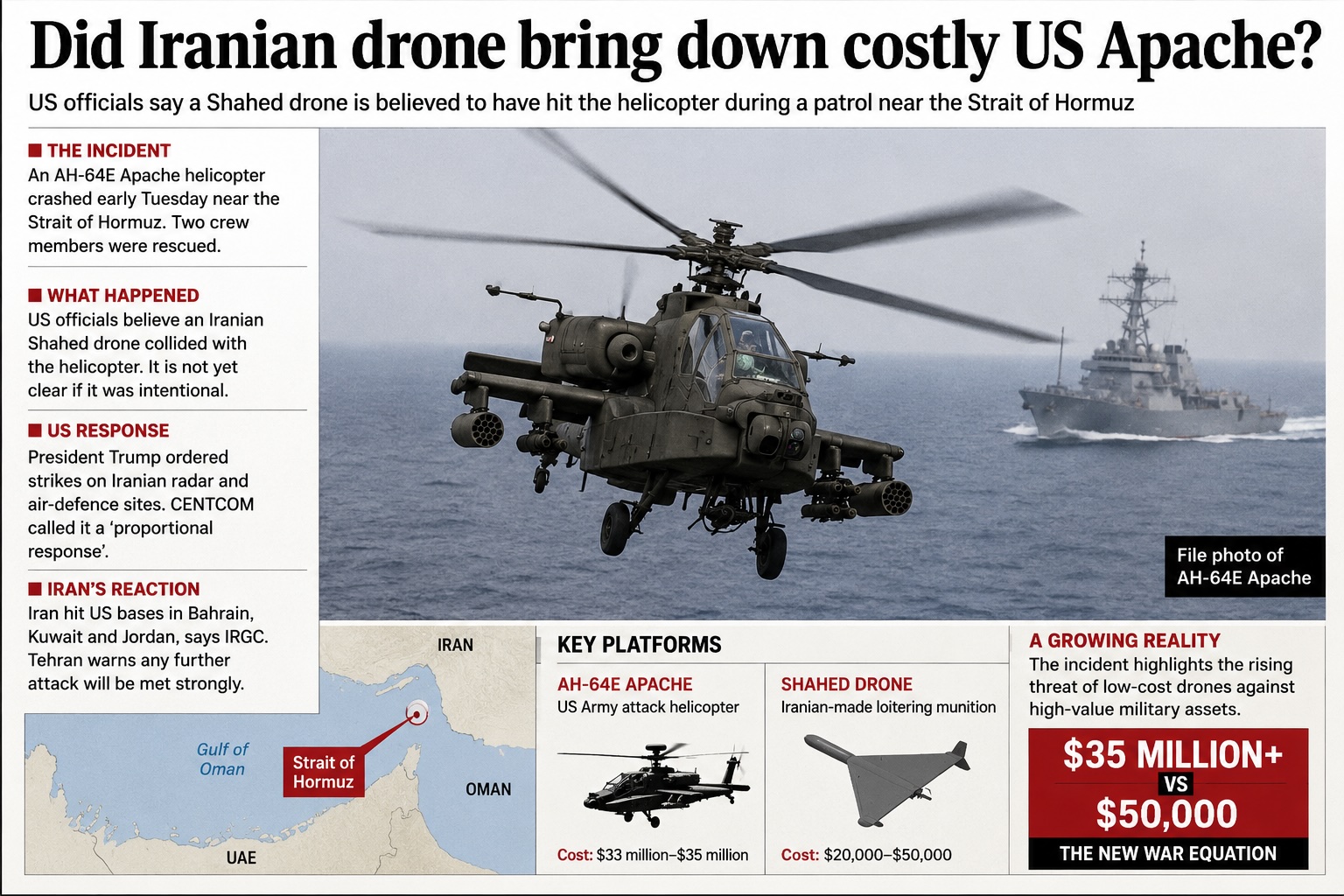
Dubai — A U.S. Army AH-64 Apache attack helicopter crashed near the Strait of Hormuz after what U.S. officials believe was a collision with an Iranian Shahed drone, an incident that triggered a new round of military strikes between the US and Iran.
The helicopter went down at about 3:30 a.m. local time on Tuesday while conducting a patrol mission off the coast of Oman, US officials said. The two crew members were rescued by a US Navy unmanned surface vessel and suffered no serious injuries.
President Donald Trump initially said on social media that Iran had “shot down” the helicopter. US officials later told reporters that an Iranian Shahed drone was believed to have been involved, although investigators had not determined whether the collision was intentional or accidental.
The incident marked the first loss of an Apache helicopter during Operation Epic Fury and the first time a US Army Apache has been brought down in combat since the Iraq War.
The loss has also highlighted the growing challenge posed by low-cost drones. An AH-64E Apache is estimated to cost between $33 million and $35 million, while a Shahed drone can cost as little as thirty thousand dollars.
In response, US Central Command (CENTCOM) said it carried out “self-defence strikes” against Iranian military targets.
“The mission is a proportional response to unjustified Iranian aggression,” CENTCOM said.
US media reports, citing administration officials, said President Trump authorised strikes on Iranian radar and air-defence facilities near the Strait of Hormuz.
Despite the action, US officials stressed that Washington was not seeking a broader conflict with Iran.
Iran responded swiftly with missile and drone strikes on US military facilities in Bahrain, Kuwait and Jordan.
“In response to the aggression of the US military, US bases in the region were targeted in a powerful attack,” the IRGC said in a statement.
The IRGC stated that its naval forces launched a drone operation against the US Fifth Fleet in Bahrain at approximately 2:30 a.m. local time and missiles struck several critical targets, including aircraft shelters and command facilities at a US-used airbase in Jordan and Kuwait.
Iranian Foreign Minister Abbas Araghchi warned that Tehran would continue to respond to any aggression.
“Iran will leave no attack or threat unanswered. Leave our region if you want to be safe,” he wrote on social media.
Iranian Parliament Speaker Mohammad Baqer Qalibaf also issued a warning to Washington.
“We prefer the language of diplomacy, but we speak other languages far more fluently. Break your commitments, and we’ll switch to what we speak best”, he said.
The latest escalation comes as efforts to preserve an April ceasefire between Iran and the United States remain fragile. Tensions have risen further in recent weeks amid renewed exchanges involving Israel and Iran-aligned groups across the region.
The downing of the Apache, one of the US military’s most advanced attack helicopters, is likely to intensify concerns about the vulnerability of expensive conventional military assets to increasingly sophisticated and inexpensive drones, a trend that has reshaped conflicts from Ukraine to the Middle East.
This article has been automatically published using a syndicated feed. The content is sourced externally and may not have been reviewed by The Freelancers Team.