



Two years ago, local friends in Pampore asked me to see something for myself.
I travelled with a cameraperson to a stretch of land beside the saffron fields and found devastation I still struggle to describe.
Rodents had dug enormous burrows through more than 2,000 kanals of farmland, devouring the corms that saffron farmers depend on to grow Crocus sativus, the flower prized around the globe for its crimson threads.
The damage wasn’t done by careless neighbours or desperate scavengers. It came from the Municipal Committee of Pampore, the very body charged with enforcing India’s waste management laws.
I returned to these fields recently at the invitation of farmers from Patalbagh, Chandhara and Galander, and what I saw was worse.
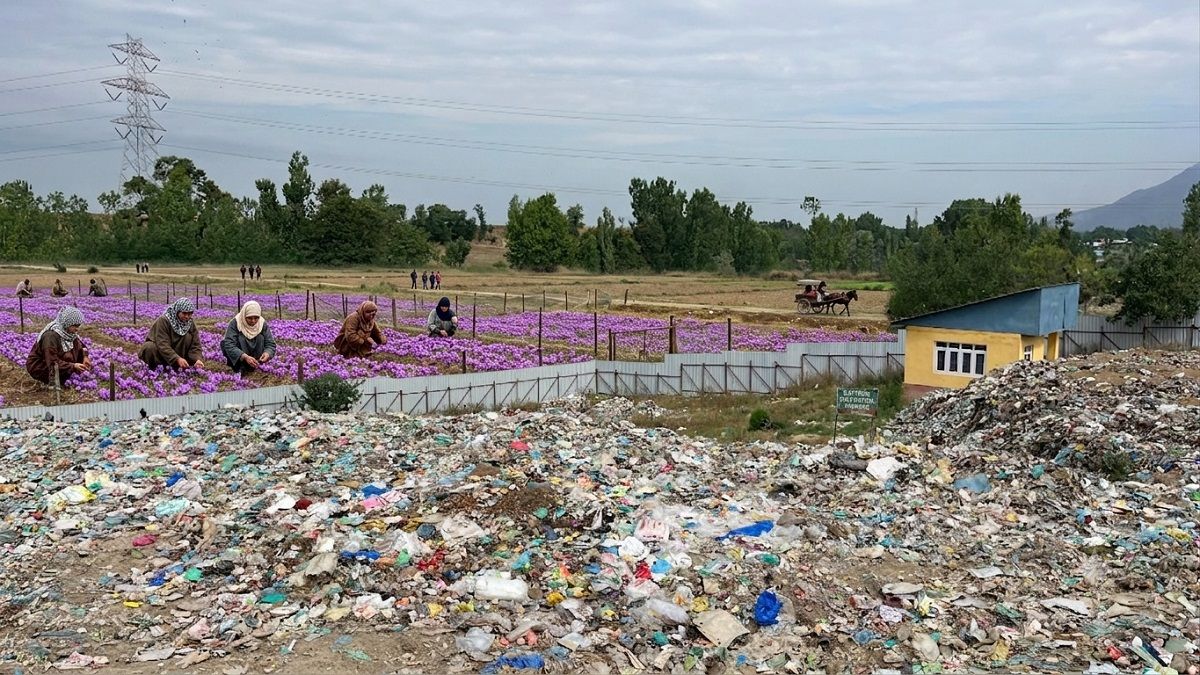
Roughly five dozen stray dogs now patrol the dumping site, drawn by the waste and dangerous enough that my group carried sticks for protection.
Women and children who once tended these fields have stopped going near them. Sheep that grazed the surrounding land have been killed by the dogs over the past three or four years, farmers told me, and shepherds have abandoned the pasture entirely.
What I witnessed was the slow strangulation of an agricultural tradition that has defined this region for centuries.
The scale of the violation is staggering.
The Municipal Committee has been dumping solid waste, along with bio-medical and plastic refuse, on some 65 kanals of saffron land for the past three to four years.
This defies the Solid Waste Management Rules of 2016, the Bio-Medical Waste Management Rules of 2016 and the Plastic Waste Management Rules of 2016, all issued under the Environment Protection Act of 1986. It also violates the newly adopted 2026 waste rules.
Plastic debris now flies over the dump with wind gusts and lands directly onto saffron beds. Farmers say the contamination has degraded the delicate soil chemistry that saffron cultivation needs to survive, and residents in Bilal Colony and the nearby Gujjar colony endure foul odors, toxic runoff and swarms of flies and mosquitoes.
Rule 15 of the 2016 regulations obligates municipalities to collect segregated waste from households, slums, commercial premises and institutions.
Pampore’s municipality collects everything mixed together and dumps it unsorted onto farmland.
The rules also prohibit landfill construction on hills or elevated ground. Patalbagh sits on a Karewa plateau, terrain wholly unsuited for a landfill under the letter of the law.
Compliance with these regulations has been absent since 2016, and the officials responsible have simply ignored a decade of legal obligation.
What troubles me most is the silence surrounding this failure.
Local media outlets and newspapers have covered the story. Farmers have petitioned repeatedly. The Jammu and Kashmir Pollution Control Committee even imposed an environmental penalty on the municipality years ago, and the dumping continued anyway.
Rule 12(b) of the 2016 regulations requires district administrations to review municipal compliance quarterly, but no evidence suggests that Pulwama’s district administration has done so here.
The Agriculture Department, which has poured billions of rupees into Jammu and Kashmir’s saffron mission, has stayed silent while the fields those investments were meant to protect are poisoned by the government’s own hand.
This pattern extends beyond Pampore.
Urban local bodies in Kashmir have already established questionable waste sites near the Jhelum River in Baramulla, Wullar Lake in Bandipora and the national highway corridor in Awantipora.
Now they have set their sights on saffron country, land that draws tourists from around the world during the October and November harvest and that anchors the livelihoods of thousands of families.
If nothing changes, agricultural experts warn that this land could turn barren within four or five years.
Accountability cannot wait any longer.
The member secretary of the Jammu and Kashmir Pollution Control Committee, the director of agriculture for Kashmir and the deputy commissioner of Pulwama owe these farmers a site visit and a binding order to close the dump immediately.
Officials should identify an alternative location for a properly engineered sanitary landfill, one that meets legal standards and sits nowhere near cultivated land.
The executive officer of the Municipal Committee and any government official who approved this site should face criminal proceedings, because what has happened in Patalbagh is a criminal act against a heritage crop that took centuries to cultivate and could vanish within a handful of harvests.
Saffron built Pampore’s identity and sustained generations of families who worked this soil way before municipal waste trucks ever arrived.
Officials sworn to protect that legacy have instead buried it under garbage, and the silence from the agencies meant to intervene has become its own form of complicity.
This article has been automatically published using a syndicated feed. The content is sourced externally and may not have been reviewed by The Freelancers Team.