



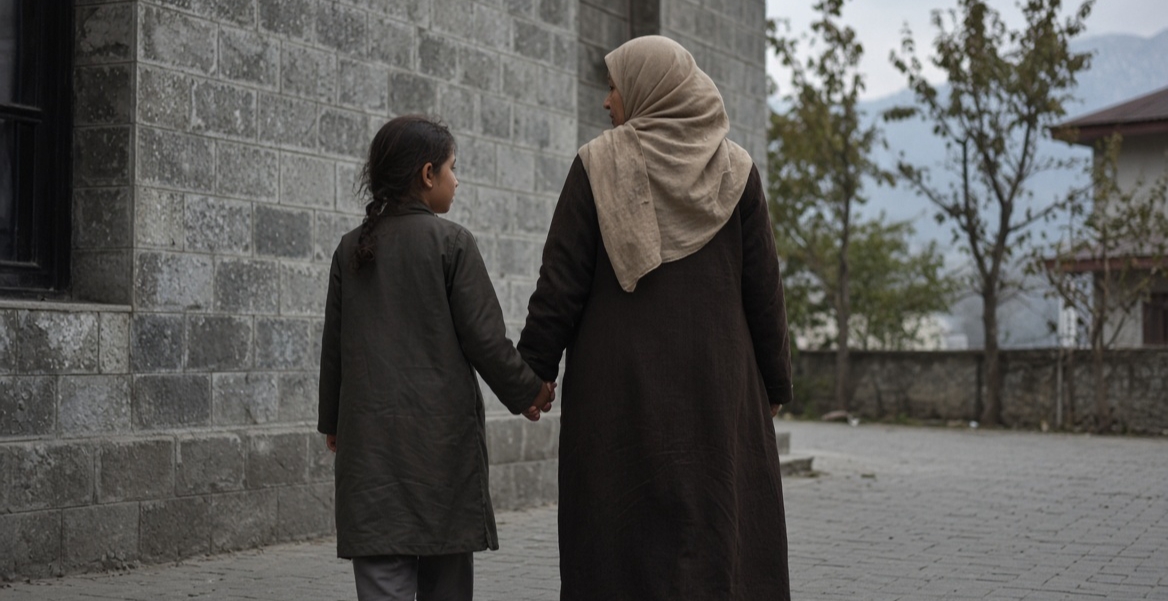
Twice a month, ZG, 8, walks into a family courtroom in Srinagar with her mother.
The journey has become part of her life. There is the trip to court, the wait for the case to be called and the possibility of returning home without the money her father was ordered to pay for her schooling and upbringing.
Six months ago, a family court issued an interim maintenance order in ZG’s favour.
The money remains unpaid.
Her case has now reached the High Court of Jammu and Kashmir and Ladakh, where Justice Rahul Bharti is examining a question that extends well beyond one child’s support order: how often should a family have to return to court when the hearing itself serves little purpose?
The dispute turns on Section 13 of the Family Courts Act, 1984.
Parliament created family courts as a more accessible forum for disputes involving marriage, children, maintenance and other domestic concerns. The law limits automatic legal representation and gives judges a more direct role in helping parties resolve their disputes.
The petition filed on ZG’s behalf argues that family courts in Jammu and Kashmir have given Section 13 a meaning that places a heavier burden on litigants.
According to the petition, courts have treated the provision as a basis for insisting on personal attendance at hearings even when a lawyer can adequately represent a party.
Rahilla Khan, the counsel arguing the case, told the High Court that the statute draws a clear distinction between legal representation and personal appearance.
Section 13 regulates the involvement of lawyers, she argued. It does not create a blanket requirement for parties to appear personally at routine hearings.
Khan set out two scenarios to explain how the provision should work.
Under the first, a litigant or minor approaches the family court personally and chooses to represent themselves. The court accepts the petition and permits self-representation. If a complex legal question later emerges, Section 13 can be invoked temporarily so the court can appoint an amicus curiae, a lawyer who assists the court on that specific issue. Once the question is resolved, the party can resume appearing personally.
The second scenario forms the central point of ZG’s petition.
When a minor and her mother approach the court through legal counsel, Section 13 comes into operation at the outset, when the court grants permission for legal representation. Once that permission has been granted, Khan argued, the provision does not require fresh activation at subsequent hearings.
Routine dates, she submitted, therefore should not automatically compel the parties to appear in person.
A court can still require personal attendance when a hearing serves a specific purpose, such as determining custody or recording evidence where personal presence is legally required.
The distinction carries practical consequences.
“A mother raising a child while waiting for unpaid maintenance pays a real price each time she returns to court,” Khan told the court, pointing to lost wages, missed school days and travel expenses for hearings that can end without a ruling.
Those costs can accumulate over months. Khan said families facing such repeated appearances can eventually abandon legitimate claims because continuing the case consumes too much time and money.
ZG’s case gives that argument a human face.
Her mother has already secured an interim maintenance order. The court has recognised a financial obligation toward the child. The unresolved question now concerns enforcement and the process surrounding it.
Khan also pressed the High Court to consider the larger purpose behind family courts.
“Besides this a question arises, what is the core purpose of a Family Court if not to strip away the procedural rigidity of standard Civil Courts?” she asked.
“The legislative mandate was to create a flexible, accessible forum for sensitive domestic matters. Yet, in practice, the current procedure has become far more rigid and unyielding than the very civil court system it was meant to reform.”
That argument becomes sharper when a child stands at the centre of the case.
Family courts dealing with children are expected to act as parens patriae, a legal guardian of last resort whose first concern is the welfare of the child. The principle gives the child’s interests a special place in judicial decision-making.
The petition argues that procedural rigidity can defeat that responsibility when court requirements become an obstacle to enforcing an order already granted for a child’s support.
Justice Bharti has allowed the issue to receive further examination. He referred to decisions of the High Court of Karnataka, including High Court of Karnataka v. State of Karnataka and Komal S. Padukone v. Principal Judge, Family Court at Bangalore City.
Those rulings also examined the extent to which family courts can insist on personal attendance from people involved in domestic disputes.
The judge directed the Registrar Judicial in Srinagar to obtain the complete trial court record and ordered the case to continue.
The petitioners want clear rules on when family courts should ask people to appear in person and when lawyers can represent them. Such rules could help thousands of families dealing with maintenance, custody and divorce.
A court date can mean lost wages, missed school, travel costs and hours spent waiting, Khan said.
ZG’s case makes that burden easy to see. She has a court order for support. Her mother keeps bringing her to Srinagar, but the money is still unpaid.
Now the High Court must decide whether families seeking help from the courts should have to keep returning simply to make an order work.
This article has been automatically published using a syndicated feed. The content is sourced externally and may not have been reviewed by The Freelancers Team.