


Moscow – Former Russian president Dmitry Medvedev on Saturday warned that Iran possesses strategic leverage capable of shaking the global economy, describing the Strait of Hormuz as Tehran’s “nuclear weapon” and the Bab el-Mandeb Strait as its “thermonuclear weapon” in the event of a wider regional war.
Speaking to journalists after returning from Tehran, where he represented Russian President Vladimir Putin at the funeral ceremonies of Iran’s late Supreme Leader Ayatollah Seyyed Ali Khamenei, the Russian Security Council Deputy Chairman said Iran had already demonstrated its power by disrupting shipping through the Strait of Hormuz during the recent conflict.
“Iran has found itself another weapon instead of an actual nuclear arm—one that is no less powerful, namely the Strait of Hormuz,” Medvedev said.
He noted that Tehran had shown its ability to influence one of the world’s most critical energy corridors.
“By blocking traffic, Iran has, of course, demonstrated its strength in that respect, and discussions and agreements are now focused on how this strait will operate going forward,” he said.
But Medvedev warned that Hormuz was only part of Iran’s strategic arsenal.
“I believe Iran has more than just this ‘nuclear weapon’ in reserve. It also has a ‘thermonuclear weapon’—the Bab el-Mandeb Strait—which could come into play in the event of future military conflicts, creating a situation in which all oil shipments and other maritime traffic would effectively come to a halt,” he said.
“I hope it never comes to that, but every country seeking conflict in the region should keep this in mind,” he added.
The Bab el-Mandeb Strait links the Red Sea to the Gulf of Aden and the Indian Ocean and serves as the gateway to the Suez Canal. Any disruption there, analysts say, would severely impact global trade and energy supplies.
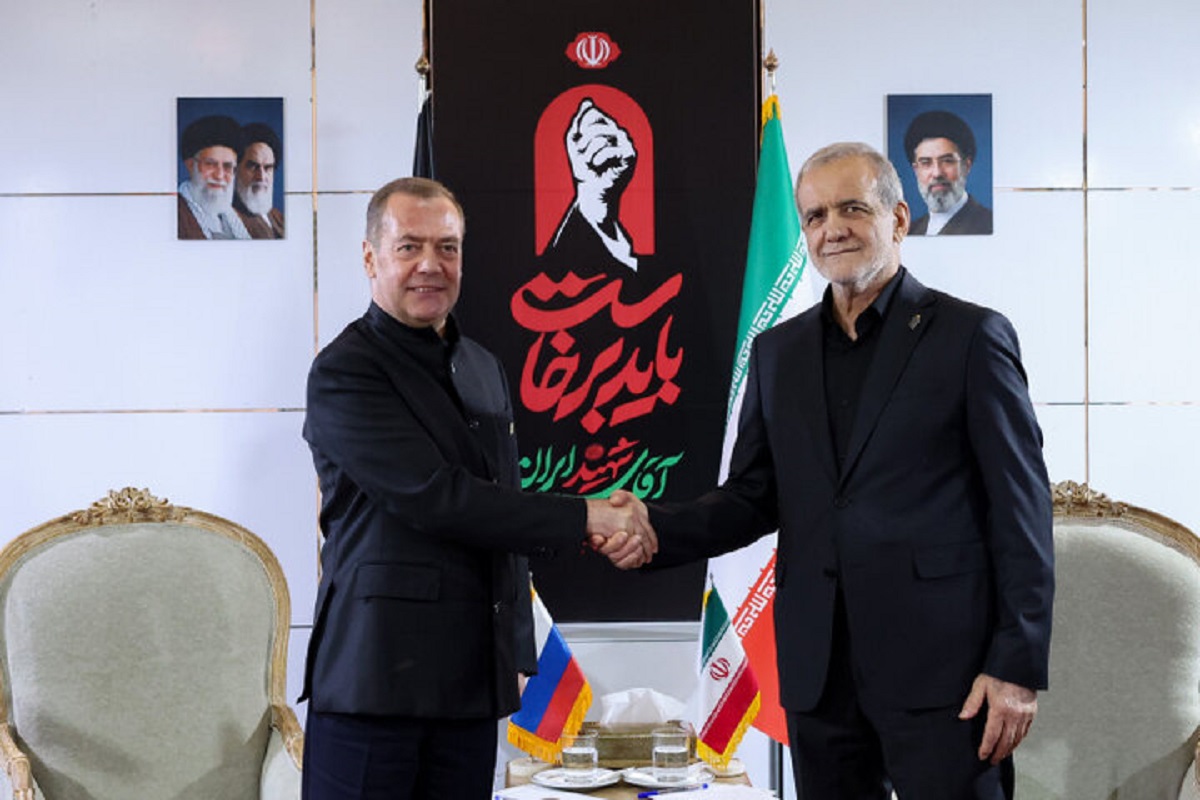
Medvedev travelled to Tehran as President Vladimir Putin’s special envoy to attend the funeral ceremonies of Ayatollah Khamenei and to deliver Moscow’s official condolences to Iranian President Masoud Pezeshkian.
According to Russia’s RIA Novosti news agency, the two leaders discussed expanding cooperation under the Russia-Iran Comprehensive Strategic Partnership Agreement. Medvedev described Tehran as “a vibrant and rapidly developing city” that had left a positive impression on him.
Reflecting on the recent conflict, the former Russian president said Iran had “passed one of the toughest tests with dignity” despite sustained attacks.
He also launched a scathing attack on Washington, describing the US military strikes on Iran as “completely unjustified”.
“The strikes were launched while negotiations were still underway,” he said, calling the attacks further evidence of “a breakdown in international legal norms”.
Reaffirming Moscow’s support for diplomacy, Medvedev said Russia continued to favour a peaceful settlement of Iran’s nuclear issue.
“Negotiations are always better than no negotiations,” he remarked, while cautioning that securing a comprehensive agreement between Tehran and Washington would remain “extremely difficult”.
He said the recently signed Memorandum of Understanding between Iran and the United States could provide a basis for future talks but acknowledged that not all political forces in Washington favoured lifting sanctions on Tehran.
Medvedev also warned that financing Iran’s reconstruction after the war would pose a major challenge.
During talks with President Pezeshkian, he said, both sides explored the idea of creating a “Platform of Sanctioned Countries” to coordinate efforts against unilateral economic sanctions.
The initiative, first proposed by Iran several years ago, could eventually evolve into an international organisation bringing together countries such as Russia, Iran, China and other states facing Western sanctions, he said.
Medvedev was among dozens of senior international dignitaries who travelled to Tehran for the state funeral of Ayatollah Khamenei, whose assassination on February 28 triggered a regional war that disrupted global energy markets and reshaped security dynamics across West Asia.
This article has been automatically published using a syndicated feed. The content is sourced externally and may not have been reviewed by The Freelancers Team.