


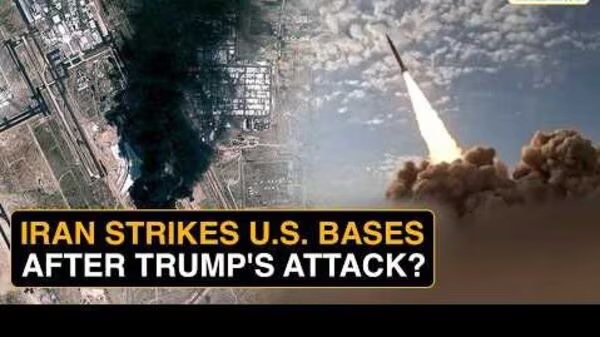
Tehran says missiles and drones targeted American bases in Jordan, Iraq and Bahrain after US strikes killed civilians at a wedding in southern Iran; Iran claims an MQ-9 drone was downed and US personnel killed, while Trump threatens an even “harder and higher” response.
Tehran — Iran launched what it described as a sweeping and “decisive” retaliatory campaign against US military positions across the Middle East after a US strike on southern Iran killed civilians attending a wedding ceremony, sharply escalating an already volatile confrontation.
The Islamic Revolution Guards Corps (IRGC) said the Iranian Armed Forces had begun a series of combined missile-and-drone operations against American bases and interests in the region, with strikes reported in Jordan, Iraq and Bahrain.
The retaliation came after a US airstrike hit a residential area in Kuhestak, in Sirik County of Hormozgan Province, where a wedding ceremony was reportedly taking place.
Iranian emergency authorities said the attack killed civilians and wounded dozens.
The Iranian Red Crescent later put the toll at five dead and 50 wounded, while IRGC statements said the victims included a child.
Wedding Ceremony Hits in Southern Iran
The initial US strike reportedly took place Tuesday night in the Bamani district of Sirik County.
Ahmad Nafisi, Hormozgan’s deputy governor for political, security and social affairs, said a residential house hosting a wedding ceremony had been targeted.
Emergency teams were immediately dispatched to the scene, officials said, while rescue operations continued as authorities assessed the damage.
Iranian Red Crescent officials initially reported two deaths and several injuries before revising the toll upward. Around 20 injured people were evacuated to medical facilities in the early stages of the rescue operation.
The Red Crescent subsequently said five people had been killed and 50 injured.
The IRGC said the attack had revived memories of earlier US-Israeli strikes on civilian targets during the previous round of hostilities, including attacks on a school in Minab and a sports complex in Lamerd.
It also cited earlier strikes on Chabahar and Konarak in Sistan and Baluchestan Province and Larak Island in the Strait of Hormuz.
Iran Fires Back Across Region
Within hours, Iran announced a major retaliatory operation.
“The decisive operations by the Iranian Armed Forces in response to the American terrorist enemy began minutes ago,” the IRGC said.
“US bases and interests across the region are now coming under attack by Iranian missiles and drones,” it added.
Iran said the operation represented a response to what it described as repeated American aggression against Iranian territory, particularly in the country’s southern regions.
The first reported targets included US positions in Jordan, where Iranian missiles were launched toward the Gulf of Aqaba.
Missiles Fired Toward Jordan
Explosions were reported in and around Eilat, with interceptors launched toward Iranian missiles headed in the direction of Aqaba, on the Jordan-Israel border.
Residents in Eilat reported seeing interceptors launched from the city toward Jordan.
Jordanian authorities issued mobile alerts shortly before 11 p.m., including in Aqaba, warning residents about the possibility of falling debris.
“The area where you are located may be exposed to falling debris,” the warning said. “We ask you to remain calm and seek shelter in the nearest building or stay inside your vehicle.”
Jordanian authorities said air defenses intercepted missiles in several parts of the country, while sirens sounded across Jordan at around 11:15 p.m.
The IRGC said the Iranian strike targeted Tabaqin camp, located on the Gulf of Aqaba coast.
MQ-9 Drone Downed
Iran also claimed that its new-generation aerospace defence system had shot down an American MQ-9 Reaper drone.
The IRGC said the downed aircraft represented the 50th advanced MQ-9 drone to have been destroyed by Iranian forces during the conflict.
US Marine Base In Jordan Hit
In a second statement, the IRGC said its Aerospace Force had carried out a “heavy ballistic-missile strike” against a US Marine facility known as Camp Titiin on the shores of the Gulf of Aqaba.
“The attack killed a large number of US personnel and destroyed several key facilities and the enemy’s attack helicopters,” the IRGC said.
The statement did not provide a precise figure for the alleged US casualties.
Iran then announced another strike against an American base in Jordan.
The IRGC said a “heavy ballistic-missile strike” hit hangars housing long-range RQ-4 and MQ-9 unmanned aircraft at the US base known as Prince Hassan.
“A number of drones were destroyed, and several pilots and flight technical crewmembers were killed,” the IRGC claimed.
“Several of their technical infrastructure facilities were also set ablaze.”
The Corps also mourned the Iranian civilians killed in the Sirik strike, accusing Washington of targeting civilians because it was unable to confront Iran’s armed forces directly.
The IRGC described the attack as “an act of desperation” and called on Jordan to stop allowing its territory to be used as a launch platform for US military operations.
US Bases In Erbil Come Under Attack
The Iranian retaliation then widened to Iraqi Kurdistan.
The IRGC said Iranian forces conducted combined missile-and-drone strikes against US bases in Erbil.
According to the Corps, the attacks destroyed a maintenance facility and warehouses containing technical equipment belonging to the US military.
Iran also claimed that the guidance system of an American surveillance balloon was destroyed.
“The valiant warriors of the Ground Forces also set fire to the fuel storage tanks at the base and killed a number of the aggressors,” the IRGC said.
US Base In Bahrain Hit
Iran’s regular Army separately announced another retaliatory operation against American forces.
The Army said it had launched the 29th phase of Operation Sa’eqeh (Lightning), using explosive-laden drones against US positions at Sheikh Isa Airbase in Bahrain.
The targets, according to the Army, included radar installations and gathering points for US forces.
It described the operation as “a forceful and extensive response to the enemy’s acts of aggression.”
Iranian forces, it said, “will exact a harsh and regret-inducing revenge on the aggressors.”
Sheikh Isa is considered a significant US military installation in the region, supporting helicopter and drone maintenance as well as reconnaissance operations.
Explosions Reported Across Iran
The escalation was not confined to Iranian retaliation.
Explosions were reported at numerous locations across Iran, including Bandar Abbas, the strategic port city on the Strait of Hormuz, as well as Qeshm Island inside the strait.
Blasts were also reported in Chabahar, Jask, Sirik, nearby Minab and Asaluyeh, one of Iran’s major energy hubs on the Persian Gulf.
Iranian reports also said Jiroft Airport in Kerman Province had been struck.
The attacks underscored the widening geographic scope of the confrontation, with several locations along Iran’s strategically vital southern coastline coming under fire.
Iran Warns Hormuz Closure Could Tighten
The IRGC said the latest US attacks would only strengthen Iran’s determination to maintain the closure it has imposed on the Strait of Hormuz.
It said the attacks had “strengthened the resolve of our warriors to crush the foreign forces interfering in Hormuz.”
The ongoing retaliation, the Corps warned, “will make the aggressors regret their actions.”
The development immediately raised fears over global energy supplies, given the Strait’s importance to international oil and gas shipments.
Oil Prices Surge On Escalation
Crude prices jumped sharply following the renewed military escalation.
Oil prices rose by around 5% on Tuesday to roughly $90 a barrel, while Brent crude futures surged about 7% to around $94.50.
Natural gas prices also climbed, with European gas prices reaching levels not seen since 2023, according to AFP.
The sharp market reaction reflected growing concern that continued attacks around the Strait of Hormuz could disrupt one of the world’s most important energy corridors.
Trump Threatens ‘Harder And Higher’ Response
Around 90 minutes after the Iranian retaliation began, US President Donald Trump said American forces were carrying out “large and powerful” attacks against Iranian targets near the Strait of Hormuz.
Trump issued the warning on Truth Social as Iranian missiles and drones were reportedly striking US positions across the region.
He threatened an even more severe response if Iran continued retaliatory attacks.
Trump said any further Iranian retaliation would trigger an attack at “a much harder and higher level.”
He added that an even larger strike was “waiting in the wings.”
“When it is over, there will be very little left of the Islamic Republic of Iran,” Trump wrote.
US Warns Americans Across Middle East
The US Embassy in Jerusalem separately warned American citizens across the Middle East that the security situation remained highly volatile and could deteriorate without warning.
The embassy urged Americans to exercise heightened vigilance, warning that the escalation could lead to flight cancellations, airspace closures and wider travel disruptions.
It also warned that US diplomatic facilities, including some outside the Middle East, had previously been targeted.
Iran and groups aligned with Tehran, the embassy said, could potentially attack additional American interests overseas.
Conflict Enters Dangerous New Phase
The rapid sequence of attacks and counterattacks marks a major escalation, with Iranian missiles and drones now being reported against American military infrastructure in several countries while US strikes continue against targets inside Iran.
The confrontation is also increasingly threatening to spill beyond the immediate battlefield, with Jordan, Iraq and Bahrain drawn directly into the exchange and the strategic Strait of Hormuz emerging as a potential flashpoint for a much broader regional and global crisis.
For Tehran, the killing of civilians at the wedding ceremony in Sirik has become a central justification for its retaliation.
For Washington, the widening Iranian strikes have triggered fresh threats of a substantially more destructive military response.
With both sides warning of further attacks, the possibility of another round of escalation now hangs over the entire region.
This article has been automatically published using a syndicated feed. The content is sourced externally and may not have been reviewed by The Freelancers Team.