


Jammu and Kashmir is on the cusp of a major economic breakthrough.
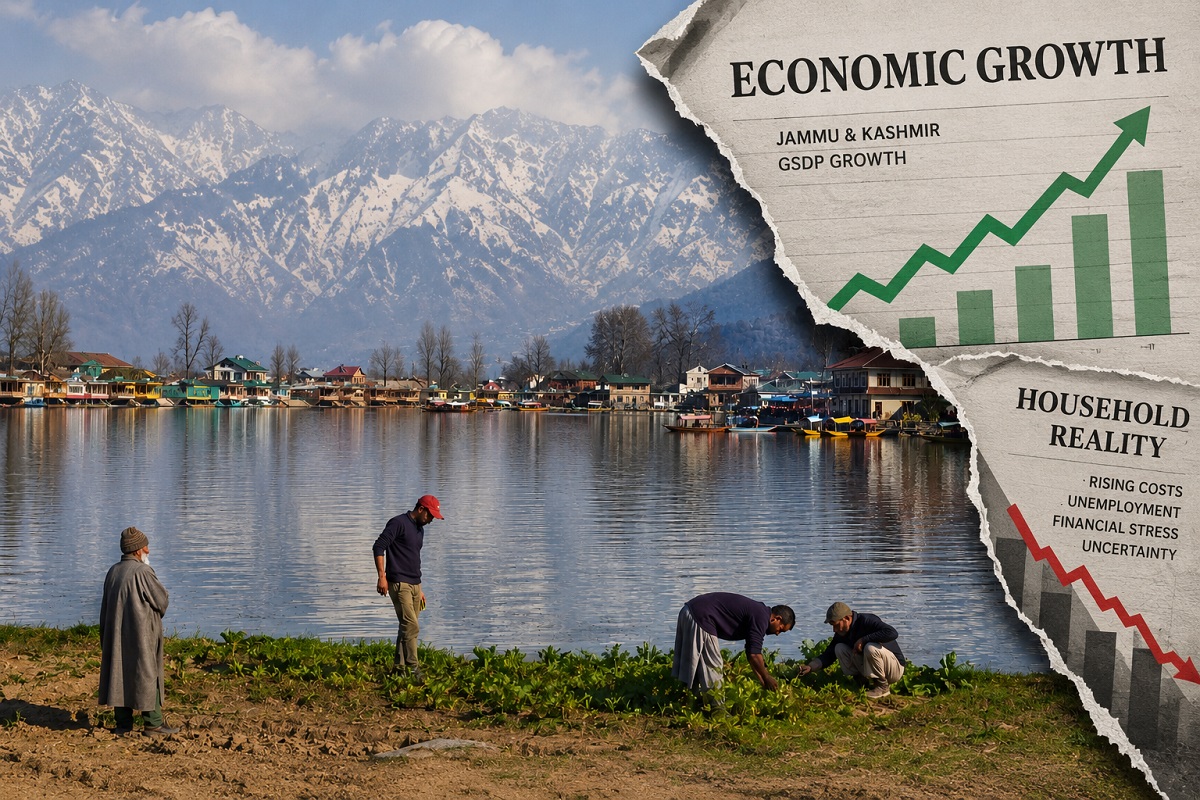
Official figures place the Union Territory’s GSDP at Rs 3,15,822 crore, with growth hitting 9.5% over revised estimates for 2025-26. Total expenditure touches Rs 1,05,958 crore, revenue surplus reaches Rs 9,378 crore, and fiscal deficit sits at 4.6% of GSDP.
These figures tell a story of planning and ambition, but they also raise a simpler question: does this growth make the average Kashmiri household financially stronger?
GDP growth remains a macroeconomic indicator, but household strength is a lived reality.
A family feels growth when income stabilizes, medical emergencies spare the savings account, and old age brings financial security.
Services contribute roughly 61% of J&K’s economy, agriculture around 20%, and manufacturing about 19%. Household prosperity depends on many sectors working together.
A shopkeeper in Srinagar, an apple grower in Shopian, a taxi driver in Gulmarg and a young graduate in Pulwama all experience the economy differently. Growth becomes meaningful when monthly cash flow improves, uncertainty drops, and wealth creation becomes possible.
Tourism stands as one of the strongest pillars of J&K’s economy. Invest India records that tourism contributes around 7% of the UT’s GDP, with 2.36 crore tourist visits in 2024.
This sector supports hotels, transport, handicrafts, food services, guides, ponywallas, houseboats and thousands of small family businesses.
The Government of India sanctioned multiple tourism infrastructure projects under Swadesh Darshan and PRASHAD, linking major destinations throughout the UT. These projects build infrastructure, generate employment and boost regional confidence.
Tourism income is seasonal and sensitive. Weather, security perception and transport disruption can affect it. A household depending solely on tourism income should build an emergency fund and diversify income sources.
Agriculture and horticulture serve as inheritance, identity and survival for many Kashmiri families. Invest India states that horticulture generates around Rs 10,000 crore annually, and J&K accounts for 91% of India’s almond output.
The region holds nearly 48% forest cover and around 18,000 MW hydropower potential.
The Holistic Agriculture Development Programme holds special importance for household income. HADP documents show a budgetary requirement of Rs 5,012.74 crore for 2022-23 to 2027-28, a projected annual addition of Rs 28,142 crore to SGDP, 18,861 new enterprises, 2.88 lakh additional jobs, and training for more than 2 lakh persons.
HADP targets 13 lakh farm families and emphasizes 2.62 lakh marginal farm families.
Effective implementation can shift families to value-added income through food processing, dairy, mushrooms, beekeeping, high-density plantation, floriculture, trout, wool, poultry and farmer producer organisations.
Kashmiri youth need skills that convert into income. Government jobs provide status, though skills and enterprise create more opportunities than public employment alone.
The future includes self-employment, digital work, tourism services, agri-enterprises, food processing, export-oriented crafts, renewable energy, and women-led businesses.
HADP’s project-wise targets show how sectoral programmes create income: 47,250 jobs through vegetable promotion, 33,600 through farm mechanisation, 25,000 through high-density plantation, 15,700 through dairy, and 7,030 through food processing.
A youth who learns protected vegetable cultivation can build a local supply chain, while a graduate can provide digital services to farmers and artisans.
Skills become income, and income becomes financial strength.
A financially strong household needs a clear structure. The first layer is liquidity, the second layer is protection, the third layer is long-term investment, and the fourth layer is skill-based income.
Fixed deposits and small savings instruments provide safety, especially for emergency funds and senior citizens.
The Department of Economic Affairs publishes official notifications on small savings returns, including the 30 March 2026 notification for Q1 of FY 2026-27.
Such instruments help families preserve capital, though they should be matched with the purpose of money.
Gold holds emotional and cultural importance in Kashmir, linked with marriage, security and family tradition. It works best as one component of a broader portfolio, since a household keeping all savings in gold may face liquidity issues and generate little regular income.
SIPs in mutual funds can help long-term wealth creation when used with discipline and patience. The Reserve Bank of India and MoSPI publish household financial data reminding us that a household balance sheet is as important as a government balance sheet.
Every Kashmiri household can follow a simple financial discipline model.
First, build an emergency fund with six months of essential expenses in safe and liquid instruments. This money serves protection. Returns are a secondary concern.
Second, buy health insurance and term insurance where suitable. A medical emergency can push a family into debt. Insurance serves as a financial shield.
Third, borrow for productive assets. Lifestyle borrowing can weaken a family. Weddings, gadgets, vehicles and social expectations can trap families in debt.
Fourth, divide savings by goal. Short-term money can remain in safe instruments, while long-term money can go into growth assets through SIPs.
Fifth, create a second income skill. A farmer can add value through storage or processing, while a student can learn digital or tourism support skills.
Kashmir has seen difficult times, and families here understand uncertainty.
A weak season, a medical emergency, a failed crop or a delayed job can disturb the household budget. Financial planning in Kashmir is essential.
A young Kashmiri should grow up believing that skill, enterprise, honesty and financial discipline build a good life.
A small business supporting three families is also nation-building. A farmer adopting technology is also an entrepreneur. A woman managing savings wisely is also an economist of her home.
Jammu and Kashmir’s growth figures are encouraging, though growth must travel from official documents to ordinary homes.
It must reach the orchard owner, the artisan, the taxi driver, the shopkeeper, the student, the employee, the widow, the pensioner and the young entrepreneur.
The future of Kashmir will be secured by households that save wisely, insure properly, invest patiently, manage debt carefully, learn skills, build enterprises and prepare for uncertainty.
A strong Kashmir economy begins with financially strong Kashmiri households.
This article has been automatically published using a syndicated feed. The content is sourced externally and may not have been reviewed by The Freelancers Team.