


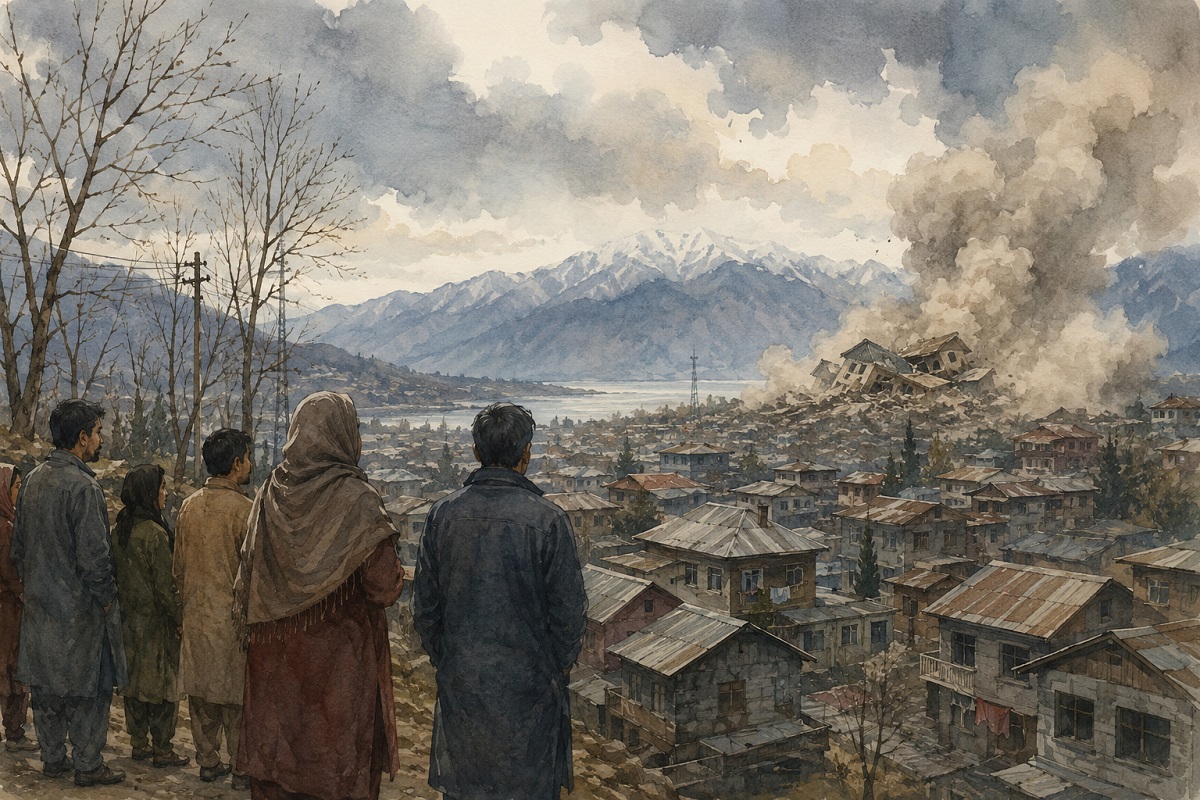
Days after a devastating earthquake sequence ripped through Venezuela, seismic waves sent people rushing out of homes and offices in Kashmir.
Streets filled with anxious residents waiting for the shaking to stop. The tremors passed without causing major damage, while Venezuela continued counting lives lost after a magnitude 7.2 foreshock gave way to a magnitude 7.5 earthquake only 38 seconds later.
Those events unfolded thousands of kilometres apart, though together they tell a story that Kashmir cannot ignore.
Venezuela’s tremor tragedy did not begin with the earthquake alone. It grew through collapsing buildings, damaged roads, disrupted communication networks and emergency systems pushed beyond capacity.
Scientists have long explained that earthquake sequences, where powerful shocks surface within seconds of one another, place enormous stress on structures already weakened by the first jolt. Human suffering rises sharply when vulnerable buildings stand in the path of that force.
Venezuela’s tragedy, however, is far from an isolated case.
Recent earthquakes in the Philippines told the same story, where powerful tremors struck exactly as earth scientists expected in active tectonic regions.
Collapsing buildings, failing infrastructure and limited preparedness transformed those natural hazards into large-scale human disasters.
Kashmir sits within that same global debate because the valley occupies one of the most seismically active continental collision zones on Earth.
Beneath the Himalaya, the Indian Plate continues moving towards the Eurasian Plate by several centimetres every year. That movement builds stress along major faults, especially the Main Himalayan Thrust, until the rocks rupture suddenly through earthquakes capable of exceeding magnitude 7.
Plate motion continues every day, even when the ground feels perfectly still.
History leaves little doubt about the consequences.
The 1905 Kangra earthquake, the 1934 Bihar-Nepal earthquake, the 1950 Assam earthquake and the 2005 Muzaffarabad earthquake rank among the most destructive earthquakes to strike the Himalayan region.
The Muzaffarabad disaster alone claimed tens of thousands of lives and exposed the devastating performance of poorly engineered buildings throughout northern Pakistan and parts of Jammu and Kashmir.
Two decades have passed since that catastrophe. Geological processes have continued without halt, while public attention has gradually shifted elsewhere.
Construction has accelerated, towns have expanded and the valley now holds far greater exposure than it did in 2005.
Large sections of urban Kashmir now stand on water-saturated sediments that decades of scientific research identify as highly susceptible to amplified seismic shaking.
Buildings founded on these deposits can experience much stronger ground motion than similar structures resting on bedrock.
Development has also moved faster than consistent enforcement of earthquake-resistant construction standards. Many buildings remain non-engineered or comply only partly with modern seismic design, while schools, hospitals, bridges, transport networks and essential utilities still await comprehensive structural assessment and retrofitting.
Earthquake science describes this combination with remarkable clarity: high hazard, growing exposure and continuing structural vulnerability.
Under those conditions, even a moderate earthquake can produce widespread human and economic damage.
Recent earthquakes elsewhere tell the same story.
Fatalities stem largely from collapsing structures rather than ground shaking alone. Damaged roads delay rescue operations, broken communication systems slow coordination, hospitals struggle as casualties rise, and financial recovery also becomes far more difficult where insurance coverage remains limited and investment in stronger infrastructure falls short.
Kashmir therefore faces three clear priorities.
Better hazard mapping comes first. Scientists understand the Himalayan tectonic system well, although important questions remain about local fault geometry, rupture behaviour and the way different parts of the Kashmir Basin amplify seismic waves.
High-resolution seismic microzonation remains limited for many urban centres. Detailed mapping would give engineers and planners a far clearer understanding of neighbourhood-level earthquake hazards.
Building safety demands equal attention.
Earthquake engineering has consistently shown that ductile design, proper reinforcement, quality construction materials and rigorous inspection greatly improve structural performance during strong shaking. Building regulations produce results only when implementation receives the same attention as legislation.
Preparing for an earthquake goes well beyond search and rescue. And financial planning is a big part of that effort.
Places with low insurance coverage often depend on government support and families’ savings after a disaster, which slows rebuilding and puts extra pressure on households.
Bringing financial preparedness into disaster planning well before an earthquake can help communities recover much faster.
Science cannot identify the day when Kashmir’s next major earthquake will come.
But science can say with confidence that large Himalayan earthquakes remain inevitable over geological timescales because plate convergence continues beneath the valley without halt.
Latest Kashmir tremors and Venezuela tragedy together brought that reality into sharp focus.
Decisions taken today about seismic microzonation, stronger building standards, safer public infrastructure and financial preparedness will determine whether Kashmir’s next major earthquake becomes another humanitarian catastrophe or a disaster whose human cost stands dramatically reduced before the ground begins to shake.
This article has been automatically published using a syndicated feed. The content is sourced externally and may not have been reviewed by The Freelancers Team.