



Kashmir’s water crisis has moved far beyond environmental debate.
The latest findings from the Comptroller and Auditor-General, combined with warnings from scientists, retired administrators and constitutional figures, point to a public policy failure that threatens drinking water, agriculture and the ecological systems that sustain the region.
Government action now needs the same scale and seriousness as the crisis itself.
The figures alone demand attention, as Jammu and Kashmir has lost 70 percent of its wetlands and waterbodies since the 1960s, according to the CAG.
Of the 697 lakes recorded in 1967, 315 have disappeared, wiping out more than 1,500 hectares of aquatic landscape.
Rivers, lakes and streams continue to shrink as glaciers retreat, while many surviving waterbodies suffer from siltation and encroachment.
Water security has shifted from a future concern to a present challenge.
The Group of Concerned Citizens has responded with a blueprint that matches the scale of the problem.
Its recent Srinagar Declaration proposes a Chief Minister-led Commission on Water Security and Ecological Restoration, a glacier, spring and watershed monitoring mission, integrated river basin management, climate-risk action plans, restoration of wetlands and floodplains, a climate and ecological risk observatory with real-time environmental data, city water action plans and a dedicated climate fund.
Declaring 2026-2035 as a Decade of Water Security and Ecological Restoration gives the region a clear framework for sustained action rather than isolated schemes.
Those proposals also expose a deeper contradiction in current policy.
The group argues that the Forest Amendment Act, 2023 weakened environmental safeguards by allowing security infrastructure within 100 kilometres of the Line of Control and the international border without environmental impact assessments or formal environmental clearances.
Road building and tunnelling continue through mountain terrain with similar consequences.
Meanwhile, the Union Environment Ministry has cleared the felling of nearly 2.8 million trees during the past three years.
Mountain landscapes have already shown the cost of unchecked construction in Himachal Pradesh and Uttarakhand. Kashmir has little reason to expect a different outcome.
Dr. Karan Singh’s intervention reinforces that conclusion.
Having served Jammu and Kashmir in several constitutional roles, he warned that unplanned infrastructure expansion has destabilised the Himalayan ecosystem.
His question cuts through the rhetoric surrounding development: why should tourists need four-lane highways if the price is permanent ecological damage?
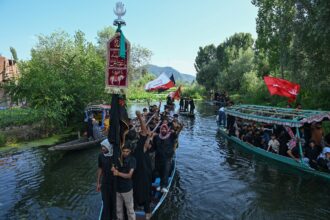
Dal Lake supplies its own answer. Its surface has shrunk to nearly one-third of its original expanse over the decades.
Kashmir’s water sources, forests and mountains support its farms, cities and economy. Public investment that erodes those foundations weakens its own promise.
Water security must become the measure of development itself.
Asphalt and concrete can always return, but vanished lakes and retreating glaciers never will.
This article has been automatically published using a syndicated feed. The content is sourced externally and may not have been reviewed by The Freelancers Team.