



By Syed Sammar Mehdi
The July sun beat down on the ghat as a young man in a white kurta and black waistcoat set out to rally a community around a lake he refused to give up on.
Sameer Baktoo had come to win over boatmen who had heard promises before, and he had chosen the toughest hour of the day to do it.
Around him, the suntanned water tribe rested in narrow strips of shade, escaping the afternoon heat, their oars lying beside them.
But Baktoo had other plans.
He greeted the men as one of their own, delivering a pep talk on “fixing responsibility”, and urging them to care for the lake that had sustained their families for generations.
“The lake can’t nap while we do,” he said.
The line drew smiles, and one by one, the boatmen rose, reached for their oars and stepped into their boats.
The ghat came alive again, and with it Baktoo’s belief that Kashmir’s lakes will recover only when the people who depend on them decide they are worth fighting for.
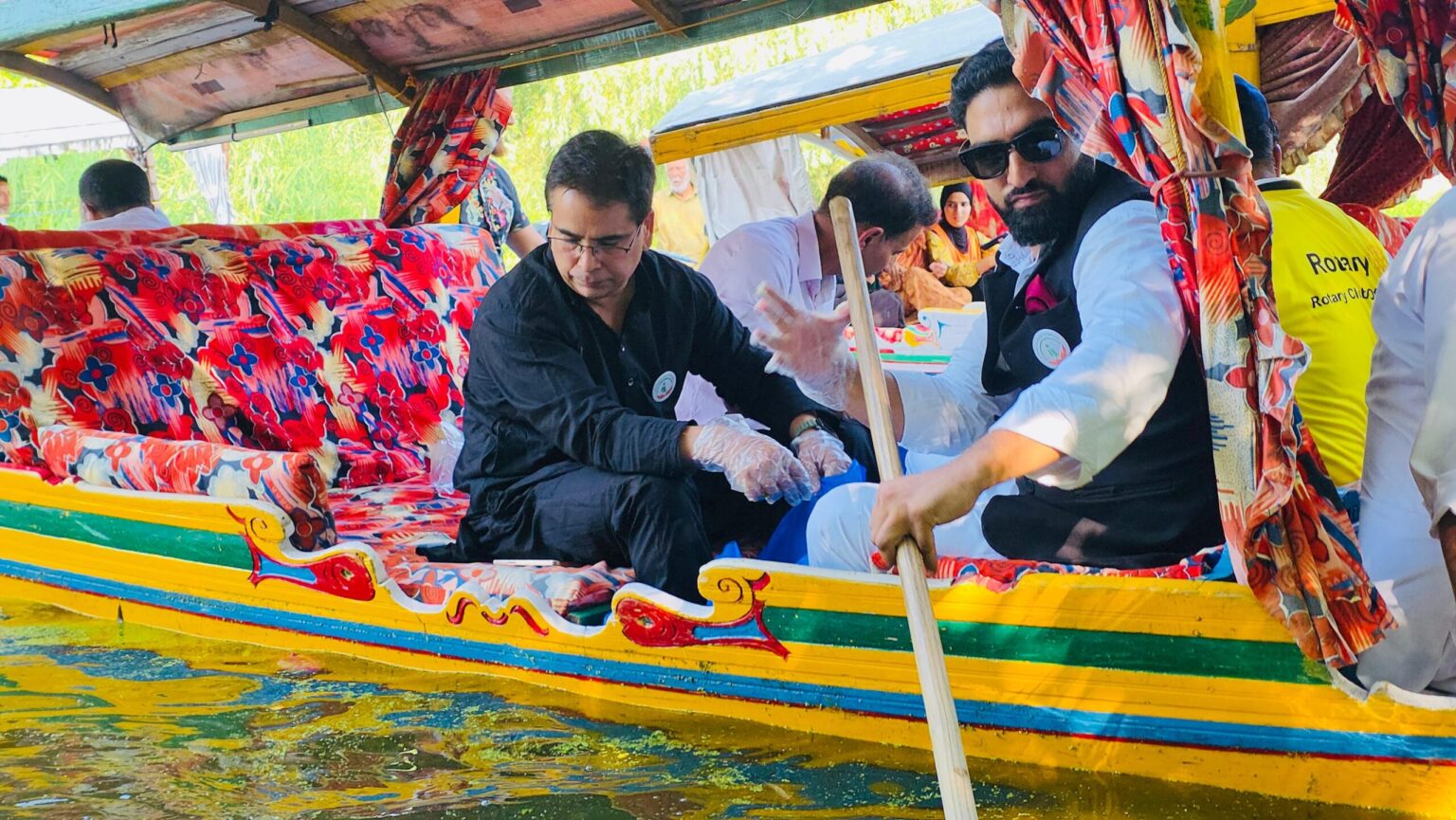
Behind him stood his corps, a small but determined band of volunteers from the Ecotourism Association of Kashmir, the Rotary Club of Kashmir, J&K Eco Watch, and Matrix Events & Productions, all gathered for Friday’s sanitization drive on Nigeen.
Gloves went on, sacks were counted, and boats pushed off from the bank toward a lake where encroachment had squeezed the shoreline and polluted drains had clouded the water over the years.
Baktoo heads the Ecotourism Association of Kashmir, and he has trained himself to notice what others sail past.
While natives and visitors look at Nigeen and see a postcard, he sees plastic tangled in the reeds, drains carrying wastewater into the lake, and a water body struggling beneath its beauty.
That contrast has turned him into one of Kashmir’s most vocal advocates for community-led conservation, urging residents to treat their lakes as a shared responsibility rather than someone else’s problem.
“We alone cannot clean our lakes and water bodies,” he told the volunteers as they checked their gloves one last time. “The water quality of our lakes, waterways and connecting water bodies is deteriorating, and all of us need to become more conscious and responsible toward protecting these natural assets.”
It was a simple sentence, though it carried the whole afternoon on its back.
The boats eased into the water, oars slicing through a surface that shimmered like hammered silver under the sun.
A local lawmaker who grew up on the shores of the lake joined the flotilla soon after, greeting members of the boatmen community before stepping into his own boat.
“I stand with the people of the water,” Tanvir Sadiq said.
Boatmen acknowledged him with nods, while families waved from huts and houseboats, with children racing along the shoreline, trying to keep pace with the boats gliding across the lake.
From far away, Nigeen still looked like the picture on every tourism poster. But up close, the story changed completely.
Plastic bottles bobbed between patches of weed, and the water near the drains ran dark and cloudy, a stubborn stain on an otherwise beautiful canvas.
A boatman, part of the stakeholder delegation, pointed toward one such drain as his boat drifted past it. “The lake still shines,” he said. “Inside, it is struggling.”
He kept going, unwilling to let the moment pass silently. “We have stayed with symbolic programmes for too long,” he said. “The real damage comes through the drains. One enters from the G.D. Goenka side. Another comes from Saderbal. Others bring untreated wastewater into the lake. Cleaning plastic helps, though sewage treatment decides whether these waters recover.”
The boat sat in silence for a moment, everyone letting the words settle like sediment. Baktoo had heard this kind of criticism many times while planning the day, and he takes it on the chin rather than brushing it aside.
His answer always paddles back to the same shore.
“We have to move beyond disappointment,” he said as the boats pressed toward Pokhribal. “People know the problems. They know who holds responsibility. Community participation has to become part of the answer because this future belongs to everyone.”
That word, responsibility, skipped from boat to boat like a stone thrown across still water.
Residents said it, so did volunteers, but an elderly man who has spent his whole life beside Nigeen said it loudest, asking why people wait around for government trucks before lifting a single scrap of trash themselves.
“Families living here earn their livelihood from this lake,” he said. “People can organise themselves and clean these banks regularly with support from authorities. That produces better results.”
God helps those who help themselves, the old saying goes, and on this water, it seemed the lake was asking for exactly that type of faith.
As the boats moved through the residential stretches, the mood shifted from environmental talk to everyday grievances.
Residents called out to Sadiq from wooden platforms, raising complaints about broken pipelines and clogged drains. The lawmaker listened patiently and promised that officials would look into the pending issues soon, mentioning that development projects worth several crores had already been approved, with technical teams set to visit shortly.
He spoke about restoring Kashmir lakes through steady teamwork with community groups and confirmed that more cleanup drives would follow in partnership with the Ecotourism Association.
By the time the boats reached Pokhribal, the talking gave way to working.
Volunteers hopped onto the bank with gloves and sacks, scooping up plastic bottles, food wrappers, and broken household junk until their bags bulged at the seams.
Dr. Touseef Bhatt of the Rotary Club called environmental protection a shared duty and pledged his organization’s continued backing.
Environmental lawyer Nadeem Qadri pushed the point further, arguing that stronger enforcement of environmental laws, paired with genuine cooperation between government bodies and local communities, will decide whether Kashmir’s water bodies survive the coming decades.
Houseboat Owners Association president Manzoor Pakhtoon rolled up his sleeves and joined the volunteers himself, a small but telling gesture from a man whose livelihood floats directly on this water.
Before the day wrapped up, Sadiq made one more announcement, promising Constituency Development Funds for a fire service station near Nigeen, a long-standing demand from the houseboat community. He walked the proposed site himself and called emergency infrastructure an important piece of the puzzle for residents living so close to the water.
Steaming cups of kahwa made their rounds once the work was done, and tired volunteers sat on their boats swapping stories about the day.
Baktoo spoke about what comes next, more awareness drives, more community pushes, all aimed at nursing Kashmir’s lakes and wetlands back to health.
His goal sails well past picking up litter along one shoreline. He wants residents, officials, tourism operators, and environmental groups to treat their lakes the way a family treats a shared home, with everybody pitching in rather than waiting for someone else to sweep the floor.
“Large environmental recoveries begin with small public actions,” he said, watching the last volunteers pack up their gear.
The sun was dipping low by the time the boats circled back to the same ghat where the boatmen had first been coaxed out of their siesta.
One stretch of shoreline looked cleaner than it had that afternoon. The drains, though, kept flowing exactly as before, and the bigger challenge stayed put, waiting patiently for tomorrow.
Baktoo looked out at the water one last time before heading home. He knows a single afternoon cannot save Nigeen Lake, and he makes no pretense otherwise.
He simply believes, the way a boatman believes in his oar, that communities win their lakes back the same slow way they lost them.
This article has been automatically published using a syndicated feed. The content is sourced externally and may not have been reviewed by The Freelancers Team.