


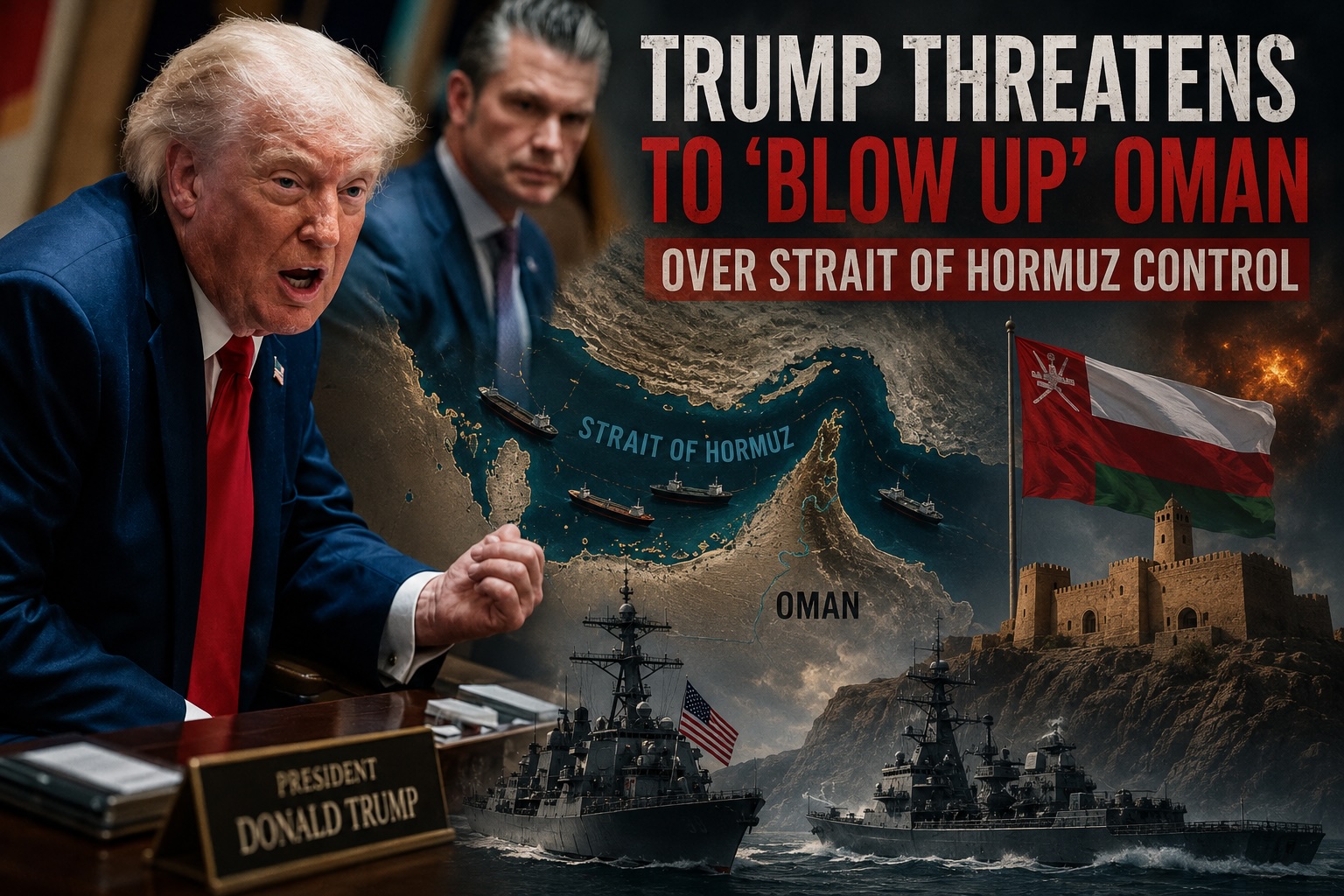
Srinagar – US President Donald Trump has now threatened military action against Oman, one of Washington’s oldest and closest allies in West Asia, warning that the United States would “blow them up” if Muscat cooperates with Iran to assert joint control over the Strait of Hormuz, a vital global energy chokepoint already at the centre of fragile negotiations to end the US-Israel war against Iran.
The extraordinary remarks, delivered during a White House cabinet meeting on Wednesday, stunned diplomats and regional observers alike, not least because Oman has for decades served as a quiet intermediary between Washington and Tehran while simultaneously hosting American military cooperation programmes.
Asked by a reporter whether he would accept a temporary diplomatic arrangement allowing Iran and Oman to jointly manage trade and shipping traffic through the Strait of Hormuz, Trump rejected the idea outright.
“No, the strait is going to be open to everybody,” Trump said. “It’s international waters, and Oman will behave just like everybody else, or we’ll have to blow them up. They understand that they’ll be fine.”
Initially, some analysts speculated that Trump may have misspoken and intended to threaten Iran rather than Oman. But those doubts faded after the US state department published an official transcript and video clip of the president’s remarks without correction or clarification, explicitly confirming that Oman was the target of the threat.
The comments mark a sharp and potentially destabilising shift in Washington’s posture toward Oman, which has long maintained close security relations with the US. The two countries signed a defence cooperation agreement in 1980 granting American forces access to Omani military facilities and later deepened ties through a bilateral free trade agreement that entered into force in 2009.
Muscat has also historically played a central role in mediating backchannel diplomacy between the US and Iran, including during negotiations that led to the 2015 nuclear accord.
But the Trump administration appears increasingly frustrated by reports that Oman has explored proposals to jointly oversee the Strait of Hormuz alongside Iran as part of broader postwar arrangements designed to reopen shipping lanes and end the three-month conflict that has rattled global energy markets.
The narrow waterway, through which nearly one-fifth of the world’s oil and liquefied natural gas passes, has emerged as the focal point of negotiations between Tehran and Washington. Before the war erupted earlier this year, the strait handled some of the world’s most strategically significant energy flows.
According to regional officials and intelligence leaks cited in recent reports, Iran has lobbied Oman to support a proposed “Persian Gulf Strait Authority”, which would establish a new maritime mechanism to oversee commercial traffic and collect fees from vessels transiting the strait.
Although Oman reportedly resisted the idea initially, recent discussions inside Muscat are said to have focused on the possible economic benefits of participating in such an arrangement and receiving a share of the revenues.
Iran and Oman would jointly supervise shipping traffic under the reported framework. In exchange, the US would gradually reduce its military footprint around Iran and end its naval blockade as part of a wider memorandum of understanding.
The White House, however, dismissed the reports as “a complete fabrication”.
Trump later reiterated that no state would be allowed to control the strait.
“We’ll watch over it, but nobody’s going to control it,” he said.
The president’s increasingly combative rhetoric comes amid signs that negotiations with Iran have stalled despite his earlier claims that an agreement was “largely negotiated”.
Speaking during the cabinet roundtable, Trump accused Tehran of deliberately dragging out negotiations in the hope of weakening his position before November’s US midterm elections.
“Iran is very much intent; they want very much to make a deal,” Trump said. “So far, they haven’t gotten there. We’re not satisfied with it, but we will be. Either that, or we’ll have to just finish the job.”
Trump also said Washington was not considering sanctions relief in exchange for Iran relinquishing its stockpile of highly enriched uranium, a key sticking point in the talks.
At the same time, he attempted to link any future agreement with Tehran to broader geopolitical realignments in the Middle East, intensifying pressure on Arab and Muslim-majority countries to formally join the Abraham Accords.
The accords, brokered during Trump’s first term, normalised relations between Israel and several Arab states, including the United Arab Emirates and Bahrain.
Trump said Saudi Arabia, Qatar, Pakistan, Turkey, Egypt and Jordan should now join the framework.
“I think they owe that to us, to be honest,” he said, adding that his envoys Steve Witkoff and Jared Kushner were actively engaged in discussions.
He also hinted that future progress with Iran might depend on additional countries signing the accords.
“I’m not sure we should make the deal if they don’t sign,” Trump said.
The continuing war has created mounting political pressure for Trump at home, where opinion polls suggest the conflict remains deeply unpopular among American voters, particularly as rising energy prices fuel inflation concerns.
But rather than moderating his rhetoric, the president appeared to dismiss the political risks entirely.
“I don’t care about the midterms,” he said.
The remarks come less than six months before elections that could determine whether Republicans retain control of Congress.
Trump’s growing willingness to threaten or use military force abroad has also reignited debate over the gap between his campaign rhetoric and his actions in office.
According to CNN analyst Aaron Blake, Trump campaigned as a critic of interventionist foreign policy, portraying his opponents as reckless warmongers who risked dragging the United States into endless overseas conflicts or even a third world war.
Yet during his presidency, Trump has amassed what critics describe as a rapidly expanding list of military interventions and threats.
Blake noted that Oman became at least the 15th country Trump has either threatened to attack, openly considered attacking, or actually struck during his two terms in office.
Most of those cases have occurred during the first 16 months of his second presidency.
According to the analysis, Trump has already launched military strikes this term in Iran, Iraq, Nigeria, Somalia, Syria, Venezuela and Yemen, while previous operations in his first term targeted several of the same countries.
The list does not include US strikes against suspected drug-trafficking vessels in the Caribbean and Pacific, operations that reportedly targeted nearly 60 boats and killed more than 190 people.
Trump has also threatened or floated military action against Canada, Colombia, Cuba, Greenland, Mexico, Panama and North Korea at various points across both presidencies.
For Gulf states watching events unfold nervously, the threat against Oman may prove especially alarming. Unlike Iran, Oman has historically been viewed in Washington as a stable partner, a diplomatic bridge and one of the few regional actors capable of maintaining working relations with all sides in a deeply fractured Middle East.
Trump’s comments have now cast uncertainty over that relationship at a moment when diplomacy in the Gulf appears increasingly fragile and the future of one of the world’s most important shipping lanes remains unresolved.
This article has been automatically published using a syndicated feed. The content is sourced externally and may not have been reviewed by The Freelancers Team.