



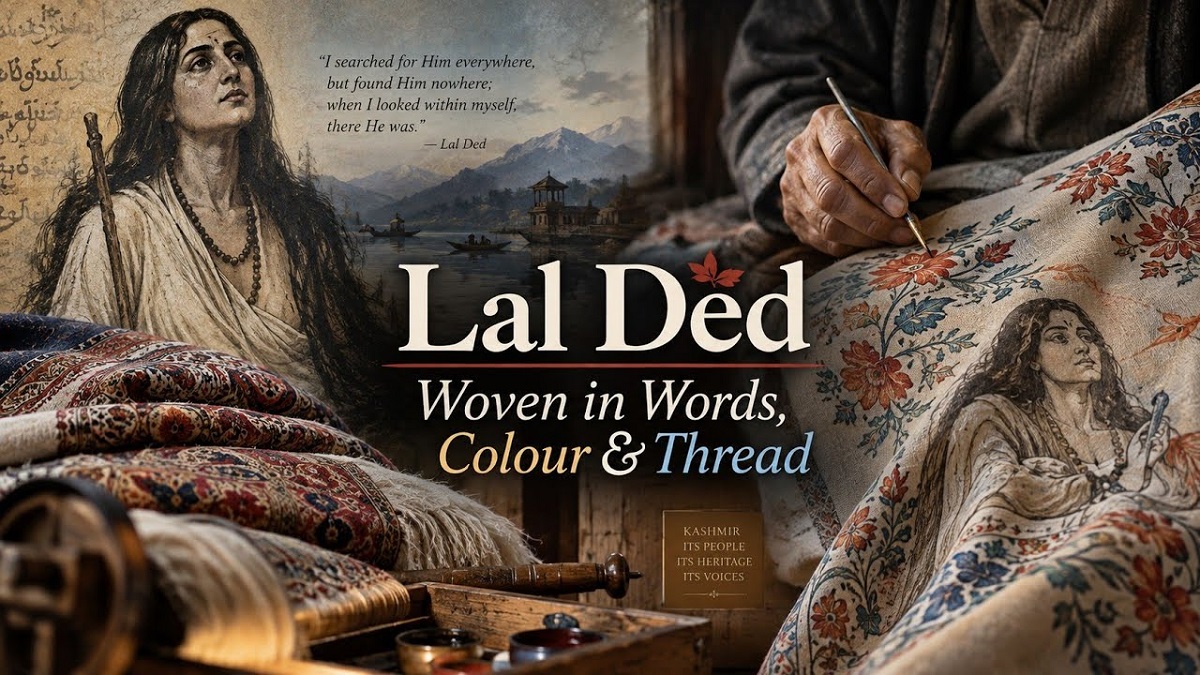
Lal Ded, also known as Lalleshwari, is among the most revered figures in the cultural and spiritual history of Kashmir. Believed to have lived in the fourteenth century, she was a mystic, poet and seeker whose vaakhs transformed the spoken language of Kashmir into a vehicle for profound spiritual reflection.
Born into a Kashmiri Brahmin family and married at an early age, Lal Ded eventually turned away from the conventions of domestic life and embarked upon a life of spiritual seeking. She is traditionally associated with the Shaiva teacher Siddha Srikantha, under whose influence her inward journey deepened. She wandered through Kashmir, speaking her verses in the language of the people rather than in the formal languages of scholarship.
Her vaakhs are remarkable for their simplicity and directness. They speak of the search for truth, the illusion of the external world, the nature of the self, suffering, spiritual awakening and the relationship between the human being and the Divine. They belong simultaneously to the personal and the universal.
One of the best-known verses attributed to Lal Ded expresses the essence of this inward search:
“I searched for Him everywhere,
but found Him nowhere;
when I looked within myself,
there He was.”
Her poetry was carried across centuries primarily through oral tradition. Recited, remembered and passed from one generation to another, the vaakhs became part of Kashmir’s collective memory. Lal Ded therefore belongs not only to literary history, but to the living cultural consciousness of the valley.
The Thread of a Living Voice
This body of work begins with that living memory.
I selected twenty of Lal Ded’s vaakhs and translated their meanings and emotional resonances into twenty visual compositions, painted directly upon the delicate surface of Pashmina shawls.
The choice of Pashmina carries its own significance. Pashmina is inseparable from Kashmir’s history of craftsmanship. Its extraordinarily fine fibre is transformed by human hands, patience and skill into a fabric of remarkable delicacy and warmth. The thread itself becomes a metaphor: fine, vulnerable and individual, yet enduring when woven together.
Lal Ded’s vaakhs have travelled through time in much the same way.
A spoken word becomes memory; memory becomes tradition; tradition becomes inheritance. In these works, that journey takes another form. The word becomes image, the image becomes colour, and colour enters the thread of Pashmina.
The shawl thus becomes more than a textile. It becomes a page, a surface of remembrance, and a meeting place between poetry and painting, word and thread, past and present.
These twenty works are my humble tribute to Lal Ded—to the woman who gave Kashmir a language for its deepest questions, and to the timelessness of a voice that continues to speak across centuries.
Her words travelled by voice.
They survived in memory.
Now they travel through colour and thread.
— Masood Hussain
This article has been automatically published using a syndicated feed. The content is sourced externally and may not have been reviewed by The Freelancers Team.